 Vastu16
Ayadi calculations in Vastu: the measurement school
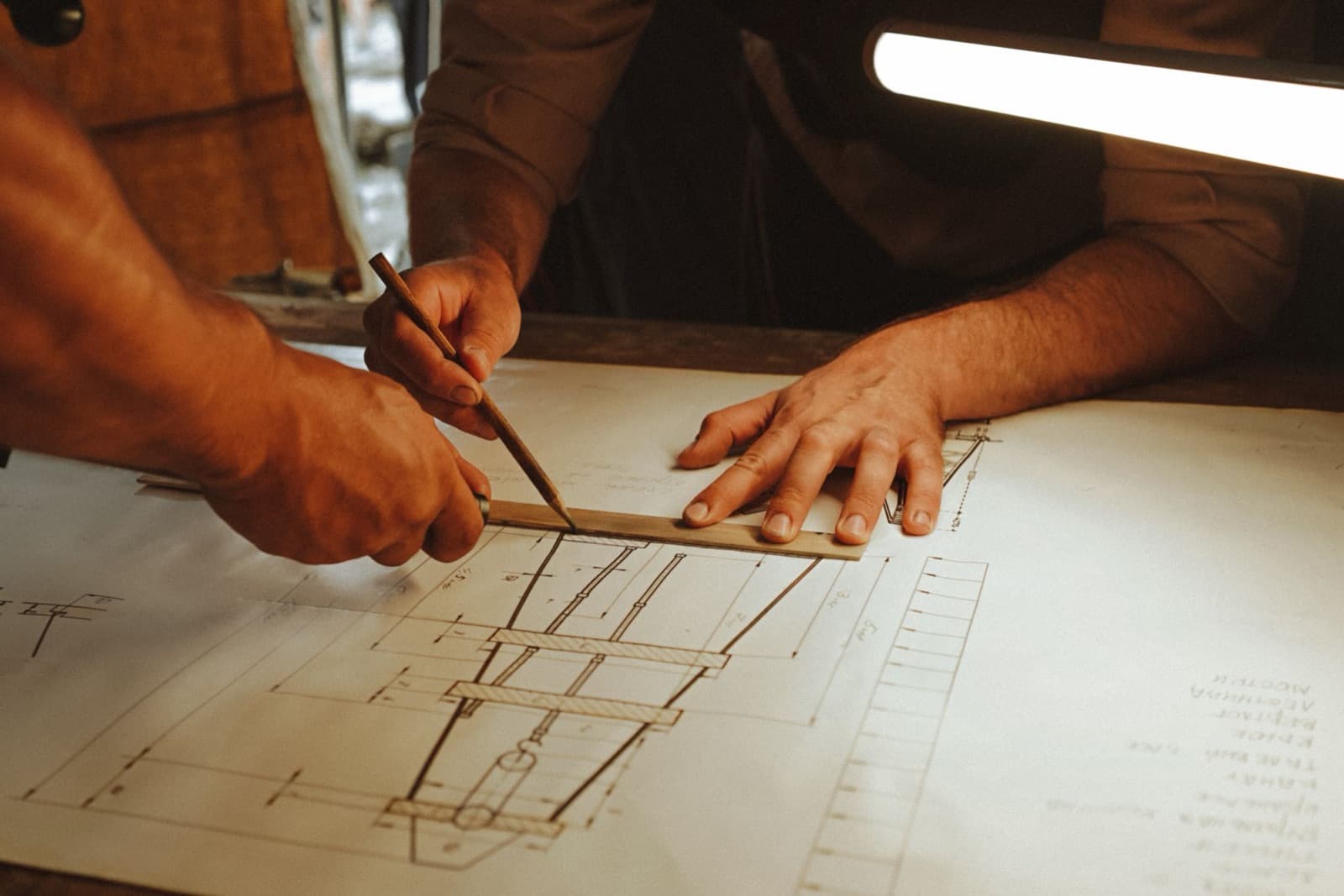
Six remainders decide an Ayadi verdict: aya, vyaya, riksha, yoni, vara and tithi. Ayadi Vastu takes a building's length, breadth or perimeter, multiplies it by a fixed number, divides by another and reads what is left over. The method comes from southern texts such as the Manasara and the Mayamata, and it judges size, not direction.
If a consultant mentioned Ayadi, they were pointing to this measurement tradition. Vastu16 does not run it, but we read the formulas in the Manasara, in P. K. Acharya's 1934 translation, so this post can show exactly what the calculation does, with one worked example clearly labelled as tradition.
Next: your whole home. Rules are general. Your plan is specific. Upload it and see where each room of your home falls under both schools.
What does an Ayadi calculation compute?
An Ayadi calculation turns a dimension into a small number. P. K. Acharya's dictionary of Hindu architecture lists the six-fold set as aya, vyaya, riksha, yoni, vara, and amsa or tithi, citing the Manasara [2]. Each has its own multiplier and divisor, and each remainder falls in a fixed group.
The Manasara names the groups in chapter XXX. Aya is a group of twelve, vyaya a group of ten, yoni a group of eight, and tithi a group of fifteen [1]. Vara counts the seven days of the week, starting with Sunday, and riksha counts the 27 nakshatras [1].
The text also says which dimension feeds which formula, and admits that authorities differ. Chapter IX (vv. 64 to 67) says some pair aya and nakshatra with length, tithi and vara with the perimeter, and vyaya and yoni with breadth [1]. Chapter XXXV (vv. 396 to 398) gives a similar pairing for mansions [1].
The point of the exercise, in the text's own terms, is to choose a dimension whose remainders read as favourable. Chapter XXX (v. 190) says a building not checked by all six formulas loses prosperity [1]. That is a traditional claim, not a measured one.
Where do the formulas come from?
The clearest set we read is in the Manasara, chapter IX, verses 63 to 93, written for villages [1]. Chapter XXX, verses 168 to 194, repeats the method for buildings [1]. Chapter XIX (vv. 6 to 11) sorts buildings into three classes by whether height, length or breadth is the standard measure, for the purpose of these formulas [1].
The Mayamata covers Ayadi as well (ch. 9, vv. 18b to 24, and 26.206 onwards). Its translator, Bruno Dagens, remarks in a note on chapter 27 that for Ayadi the author seems to have used general and incomplete data [3][5]. Dagens places the Mayamata in South India, between the early 9th and late 12th centuries [3].
The unit matters as much as the formula. The Manasara builds its units up from the barley-corn: eight barley-corns make one angula, and each measure comes in three kinds, reckoned with six, seven or eight barley-corns (ch. II, vv. 46 to 48) [1]. Twenty-four angulas make a small cubit, twenty-five a prajapatya cubit used for mansions, and twenty-six or twenty-seven make larger cubits for other buildings and villages (vv. 49 to 57) [1]. Acharya glosses one angula as about three-fourths of an inch [1].
Work through one room: a worked example (tradition)
Here is an Ayadi calculation for a room 10 cubits long and 7 cubits wide, using the chapter IX formulas [1]. The perimeter is 34 cubits.
| Result | Dimension | Multiply by | Divide by | Remainder | How chapter IX reads it |
|---|---|---|---|---|---|
| Aya | Length 10 | 8 | 12 | 8 | Compared with vyaya |
| Vyaya | Breadth 7 | 9 | 10 | 3 | Aya greater than vyaya is favourable (vv. 75 to 77) |
| Riksha | Length 10 | 8 | 27 | 26 | Even remainder read as unfavourable (vv. 78 to 79) |
| Yoni | Breadth 7 | 3 | 8 | 5 | Read by the order of the eight yonis (v. 80) |
| Vara | Perimeter 34 | 9 | 7 | 5 | Thursday if Sunday counts as 1; Thursday is in the favoured list (vv. 81 to 85) |
| Tithi | Perimeter 34 | 9 | 30 | 6 | Acceptable: not new moon, eighth or ninth (vv. 86 to 87) |
So the same room passes some tests and fails one. Now switch chapters. Chapter XXX multiplies the length by six for the Samchita class of building (vv. 177 to 178) [1]. Ten times six is 60, which leaves 0 when divided by twelve. With breadth times seven for vyaya (v. 179), 49 leaves 9. Aya is now less than vyaya, and chapter XXX asks for aya greater and vyaya less (vv. 191 to 194) [1]. Same room, same text, different verdict.
Do it yourself in five steps
- Pick the unit and say which cubit you used.
- Measure length, breadth and perimeter in that unit.
- Multiply each by the chapter's multiplier and divide by its divisor.
- Write down each remainder.
- Note which chapter and which class of building you followed, because the multipliers change.
How does Ayadi differ from direction-based schools?
Direction schools ask where a room sits. Ayadi asks how big it is. That one difference changes everything a buyer can do with the result.
The traditional 8-direction and 16-zone schools read each room's position around the centre of the home. In Vastu16's rule table, a kitchen in the north-east is one to avoid, severity 4 of 5, whatever its size. That holds in the 8-direction school and in the 16-zone school's NNE and NE zones, while its ENE zone is neutral [4]. Ayadi would give the same kitchen a verdict based on its length and breadth, wherever it sat. Our guide to the two direction schools explains how they cut the compass.
The inputs differ too. A direction school needs a North line and a floor plan. Ayadi needs exact dimensions in a traditional unit and a choice of chapter and cubit. Two consultants can both "follow Ayadi" and still reach different remainders because they used different cubits.
Neither approach has been tested for outcomes in any source we opened. They are traditions with different logic, as our map of the types of Vastu schools sets out.
Checklist
Using it today
Ayadi is most usable before anything is built. An architect drawing an independent house can nudge a room by a few inches to change a remainder, if the family wants Ayadi followed. A flat buyer cannot change a single wall, so for flats the method mostly explains a consultant's comment rather than guiding a decision.
Three limits are worth knowing before you act on an Ayadi reading. The formulas vary between chapters of one text, as the worked example shows [1]. The unit varies: the angula comes in three sizes, and the text lists four cubits [1]. And the Mayamata's own translator says its formulas are incomplete [5].
We have not found a published survey of how widely Ayadi is used today, so we make no claim about how common it is. For terms such as aya, pada and Brahmasthan, see the Vastu glossary. The texts behind the method are covered in our posts on the Manasara and the Mayamata.
What is tradition and what is fact
Tradition
- The six formulas and their divisors: Manasara, ch. IX, vv. 63 to 93, and ch. XXX, vv. 168 to 194 [1].
- Aya greater than vyaya is favourable: Manasara, ch. IX, vv. 75 to 77 [1].
- A building not checked by all six formulas loses prosperity: Manasara, ch. XXX, v. 190 [1].
- Ayadi in the Mayamata, ch. 9, vv. 18b to 24 [3].
- The cubit ranges from 24 to 27 angulas, each reckoned in three sizes of six, seven or eight barley-corns: Manasara, ch. II [1].
Physical and scholarly fact
- The Mayamata's Ayadi data look general and incomplete: Dagens, note 14 on ch. 27 [5].
- No source we opened tests whether Ayadi dimensions change outcomes.
Where Vastu16 fits
Vastu16 reads directions, not dimensions. You can check your floor plan under the 16-zone and 8-direction schools for free, and every rule it applies is listed on our methodology page. The check does not compute Ayadi, does not ask for cubits, and does not judge room sizes.
Questions people ask
What is Ayadi in Vastu?
Ayadi is a set of formulas from southern texts that judge a building by its measurements. You multiply a length, breadth or perimeter by a fixed number, divide by another, and read the remainder. The Manasara names six results: aya, vyaya, riksha, yoni, vara and tithi. Each remainder is then read as favourable or not, according to the text.
Does Ayadi apply to flats?
The texts wrote Ayadi for whole buildings and settlements, measured in traditional cubits, and they say nothing about apartments or single rooms in a flat. A buyer of a built flat cannot change its dimensions in any case. The method is most usable at the design stage of an independent house, if the family wants to follow it.
Does Vastu16 use Ayadi?
No. Vastu16 runs two direction-based schools, the 16-zone and the traditional 8-direction, which read where each room sits around the centre of the home. Ayadi reads dimensions instead, and its results depend on the cubit and the chapter you follow. We describe it here as tradition so you can understand a consultant who mentions it.
Related posts
Types of Vastu: 8-direction, 16-zone, grid and astro
Vastu is not one system. The main schools practised today, how each cuts a plan, what each needs from you, and why their answers differ.
Manasara: the Vastu text and Acharya's translation
The Manasara is one of the most cited Vastu texts. What it covers, how P. K. Acharya's translation framed it, and what it says about homes.
Mayamata explained: what the Vastu text actually says
The Mayamata is a southern Indian treatise on building. What its chapters cover, what it says about sites and houses, and where to read it.

Sources
- Manasara (Acharya translation, 1934): measurement chapters and the Ayadi formulas
- A Dictionary of Hindu Architecture (Acharya)
- Mayamata (Dagens critical edition and English translation), Vol. I
- Vastu16 methodology and rule table (internal)
- Mayamata (Dagens critical edition and English translation), Vol. II