 Vastu16
Why Vastu consultants disagree about the same plan
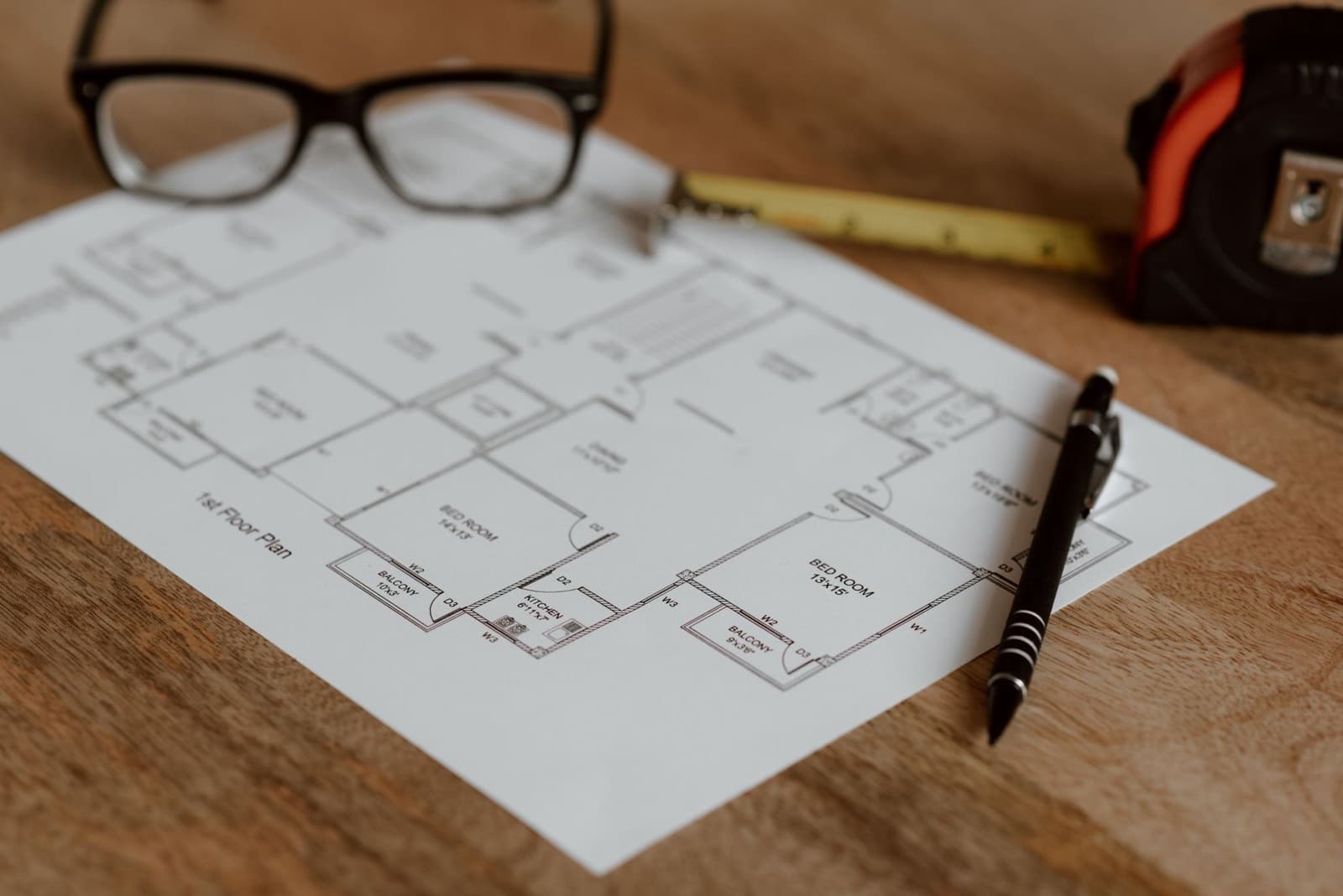
Four reasons explain why Vastu consultants give different advice on one plan: they follow different schools, they take North from different places, they find the centre of the home differently, and they use different remedy traditions. Each choice can move a room into a different zone or change what counts as a fix.
Conflicting Vastu advice is common enough that Vastu16 was built to show two schools side by side instead of one verdict. This post walks through each source of disagreement with real readings from our rule table, then gives you five questions that make two opinions comparable.
Next: your whole home. Rules are general. Your plan is specific. Upload it and see where each room of your home falls under both schools.
Reason 1: Do they follow different schools?
The two schools most often practised today cut the plan differently. The traditional 8-direction school uses eight sectors of 45 degrees. The 16-zone school uses sixteen zones of 22.5 degrees, each with its own rules [1]. Our guide to the 16-zone and 8-direction schools lays out the degrees.
The same room can get opposite readings. These come straight from Vastu16's rule table [1]. The 16-zone school reads each 45-degree direction as three zones, so its column names the zone:
| Room and position | Traditional 8-direction | 16-zone |
|---|---|---|
| Toilet in the west | Good | W zone: avoid, severity 2 of 5 (WSW neutral, WNW good) |
| Toilet in the south-east | No rule (neutral) | SE zone: avoid, severity 4 of 5 (ESE good, SSE neutral) |
| Kitchen in the south | No rule (neutral) | SSE and S zones: good (SSW neutral) |
| Main door in the south | Avoid, severity 2 of 5 | SSE and S zones: neutral; SSW zone: avoid, severity 4 of 5 |
| Toilet in the north-east | Avoid, severity 5 of 5 | NNE and NE zones: avoid, severity 5 of 5 (ENE neutral) |
The classical texts disagree too. The Brihat Samhita (ch. 53, sloka 118) and the Vishwakarma Prakash (ch. 2, vv. 94 to 97) put the kitchen in the south-east [5][4]. The Manasara (ch. XXXVI, v. 26) puts kitchens in the north, north-east or Parjanya quarter [3]. The Mayamata places latrines on the south-west Nirrti square [10], a position the 8-direction school and the 16-zone school's SW zone both rate as one to avoid for a toilet, severity 4 of 5 [1].
Reason 2: Did they use a different North?
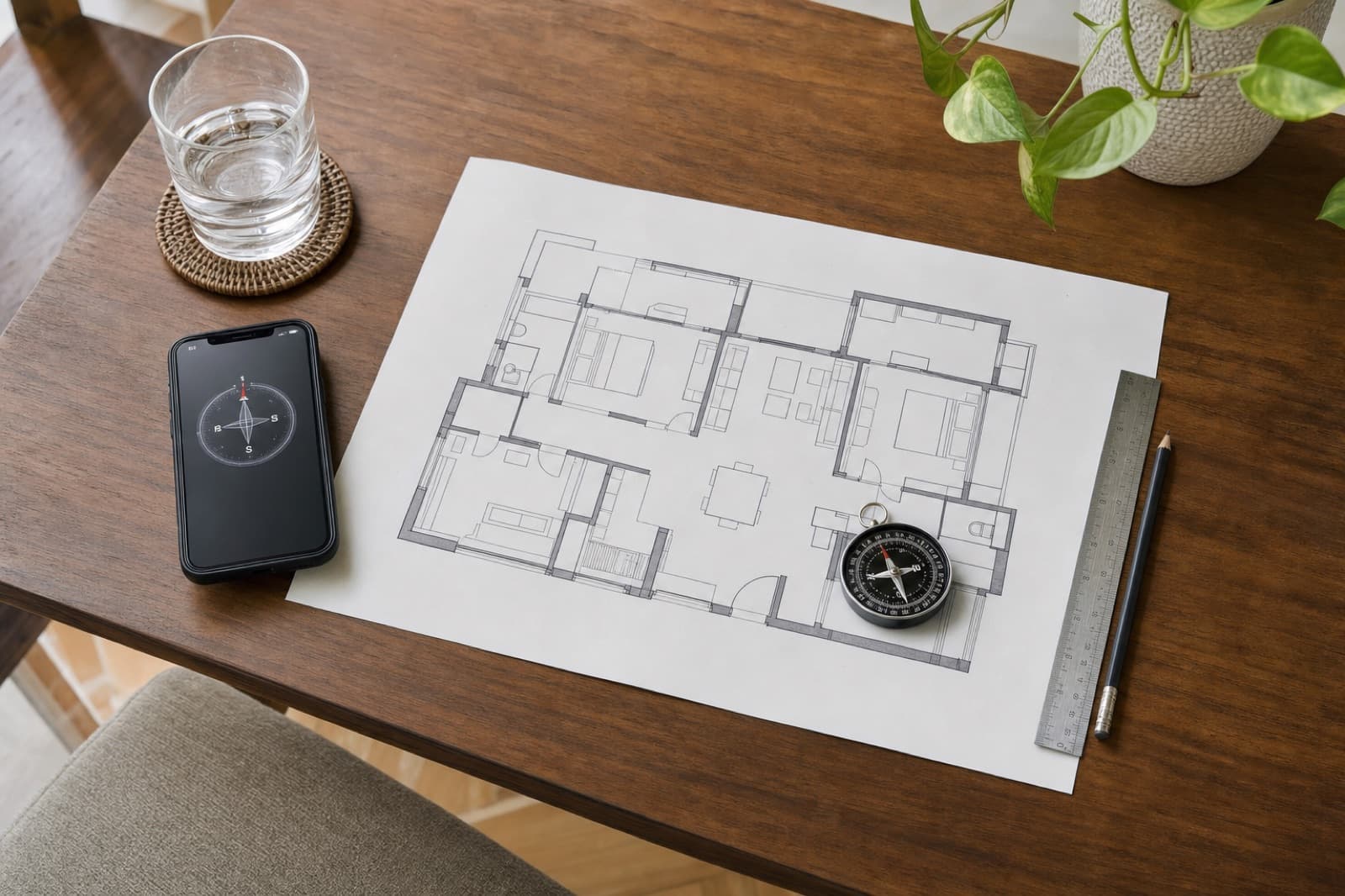
Every reading starts with a North line, and there are three in play. True North points to the geographic pole. Magnetic North is where a compass points. The angle between them is the declination, positive when magnetic North lies east of true North [6].
In Indian cities the gap is small. NOAA's World Magnetic Model gives about 0 degrees for Mumbai, 1.3 degrees east for Delhi and 1.1 degrees west for Bengaluru (checked 2 October 2026) [8]. In New York it is about 12.5 degrees west, and in Seattle about 14.9 degrees east [8]. Declination belongs to the site, not the consultant. A correction copied from Seattle would put a Mumbai North line about 15 degrees out.
Buildings add their own error. NOAA notes that local magnetic anomalies of 3 to 4 degrees are not uncommon, and that more than 10 degrees is rare but possible [7]. NOAA also names man-made sources, such as a buried iron pipe, among the main sources of compass error [6], so steel in a flat can pull a phone compass further.
A 16-zone slice is only 22.5 degrees wide, so a 10 degree shift moves many rooms across a line. The classical texts did not use a compass at all: the Mayamata (ch. 6) and Manasara (ch. VI) fix east by a gnomon's shadow [2][3]. See our guide to finding North for Vastu and the post on trusting a brochure's north arrow.
Reason 3: Did they use a different centre and outline?
Every zone is measured from the centre, so moving the centre moves every room. Consultants differ on three choices. Is the outline the flat's walls alone, or walls plus balconies? Is a missing corner filled in to make a rectangle, or left as it is? Is the centre the middle of the bounding rectangle, or the balance point of an irregular shape?
The texts give the centre real weight but differ on its size. The Mayamata divides a house into a 64-square grid (ch. 27, vv. 15b to 16), on which Brahma holds the four central squares (ch. 7), while the Manasara marks the 81-square grid within a house (ch. XXXVI, v. 14), and on that grid Brahma takes the nine central plots (ch. VII, vv. 110 to 111) [2][10][3]. A nine-square centre is larger than a four-square one, so a room near the middle can read as "centre" in one method and as a direction in another.
Vastu16 states its own choice on the methodology page: the centre is the middle of the outline's bounding box, the central zone is the middle cell of a three by three grid, and a room takes the zone holding most of its area [1]. Our post on finding the centre of a house shows the alternatives.
Reason 4: Do they use different remedy traditions?
Two consultants can agree on the problem and still give opposite advice on the fix. Remedy traditions range widely. Some lean on moving furniture or changing how a room is used. Some lean on objects. Some lean on rebuilding.
Vastu16's remedy library works in a fixed order: free steps first, then low-cost ones, then changes at plan or renovation stage [1]. For a toilet in a zone the schools rate poorly, the free steps are keeping the door closed and the room dry, clean and ventilated. The low-cost step is an exhaust fan. The bigger step, only at plan stage, is moving the WC [1]. Our post on north toilet remedies walks through one case.
Other practices sell remedy objects. One commercial practice's website, for example, sells home decor objects as remedies "without demolition" and offers a course on allocating zones for remedies based on horoscopes [9]. Vastu16 does not recommend products or use astrology. When advice includes a purchase, ask what the object does that a free step does not.
How to compare when Vastu consultants give different advice
Put the same five questions to each consultant and write the answers in a table. Disagreement usually traces back to one row.
| Question | Consultant A | Consultant B |
|---|---|---|
| 1. Which school do you follow: 8-direction, 16-zone, a grid, or something else? | ||
| 2. How did you find North: true North from a map, a compass on site, or the brochure arrow? Did you correct for declination? | ||
| 3. Where is the centre, and is the balcony inside the outline? | ||
| 4. Which rooms did you read, and in which zone did you place each one? | ||
| 5. What is each remedy based on: a text, a school rule, or your own practice? Does it need a purchase? |
Checklist
On your next consultation
- Ask for the reading in writing, with the North line and centre drawn on your plan.
- Check the North line against a map yourself before you discuss rooms.
- If two readings differ, find the row in the table where they split.
- If they split on school, both may be correct within their own rules.
- If they split on North or centre, one measurement is likely off. Re-measure before you act.
- Prefer free and reversible steps until the readings agree.
What is tradition and what is fact
Tradition
- Kitchen in the south-east: Brihat Samhita, ch. 53, sloka 118 [5]; Vishwakarma Prakash, ch. 2 [4].
- Kitchens in the north or north-east: Manasara, ch. XXXVI, v. 26 [3].
- House centre on 4 squares of a 64-grid (Mayamata, ch. 7 and 27) or 9 squares of an 81-grid (Manasara, ch. VII and XXXVI) [2][10][3].
- Zone readings and severities: Vastu16's rule table, both schools [1].
Physical fact
Where Vastu16 fits
Vastu16 does not settle which school is right. It makes the disagreement visible. You can read your plan under both schools side by side: the free check marks North, places each room by zone in the 16-zone and traditional 8-direction schools, and shows where the two schools split. It does not visit the site or measure the compass for you. If you want one of our consultants to look at the result, our consultation page explains what a review covers.
Questions people ask
Why do Vastu experts give different advice?
Four things usually explain it. They follow different schools, which divide the compass into 8 or 16 parts with different rules. They take North from different sources. They find the centre of the home differently. And they draw on different remedy traditions. Two careful consultants can read the same plan and reach different verdicts without either one making an error.
Which Vastu consultant should I trust?
Trust the one who can explain their method. Ask which school they follow, how they found North, where they put the centre, which rooms they read and what each remedy is based on. A consultant who answers all five plainly, puts it in writing and does not sell you an object is easier to check than one who does not.
Can two Vastu readings of the same flat both be right?
Yes, within their own rules. A toilet in the west is rated good in the traditional 8-direction school and, in the 16-zone school's west zone, one to avoid, severity 2 of 5. Both readings follow their school correctly. The useful question is not who is right, but which rules each reading applied and whether the measurements behind it hold up.
Related posts
Toilet in the north: why the two schools disagree
The 16-zone school reads a north toilet at severity 5; the 8-direction school at 2. What each says, why, and what to do about it.
Is the brochure's North arrow right? How to check it
How to check the Vastu direction of a flat: test the brochure's North arrow against a satellite map, a compass and the sanctioned plan.
How to find the centre of a house for Vastu
Every zone is measured from the centre. How to find it on a rectangular plan, an L-shaped flat and an irregular plot, step by step.
Sources
- Vastu16 methodology and rule table (internal)
- Mayamata (Dagens critical edition and English translation), Vol. I
- Manasara (Acharya translation, 1934)
- Vishwakarma Prakash (Sanskrit with Hindi commentary "Abhaya")
- Brihat Samhita of Varahamihira (chapter on house-building)
- NOAA NCEI Geomagnetism FAQ
- WMM Accuracy, Limitations, and Error Model
- World Magnetic Model (WMM) product page
- MahaVastu home page
- Mayamata (Dagens critical edition and English translation), Vol. II