 Vastu16
How to take a compass reading in a flat for Vastu
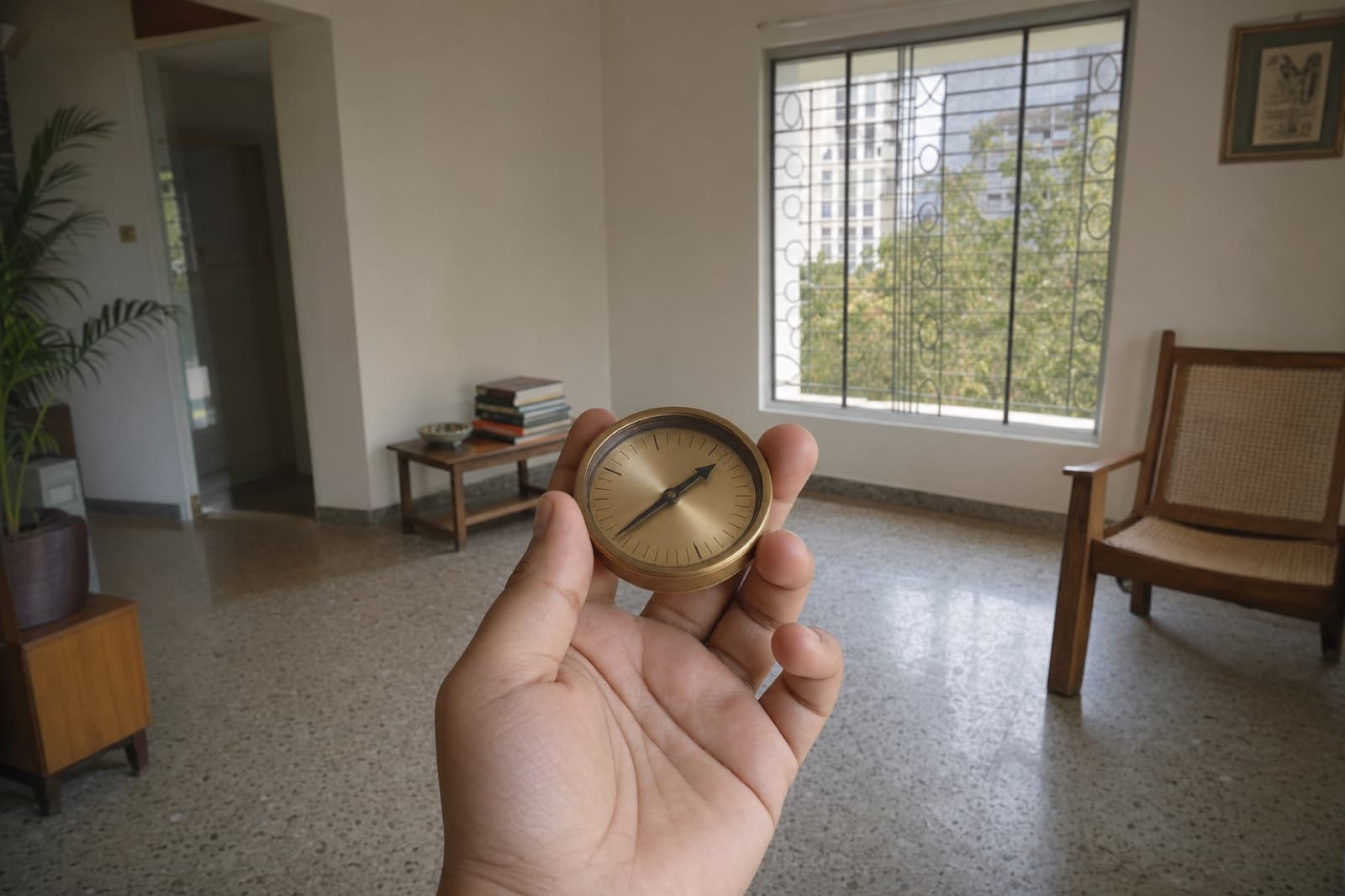
Next: your whole home. Rules are general. Your plan is specific. Upload it and see where each room of your home falls under both schools.
The short answer
Take three readings: just inside the main door, at the centre of the flat and near the balcony or far wall. Calibrate the phone first, hold it flat and stay a metre from steel. Write each bearing down, discard any reading more than 10 degrees from the others, and average the rest. The routine takes about five minutes.
What follows is the on-site version of how to use a compass for Vastu in a flat. Why phones drift indoors is covered in our post on phone compass accuracy. Here we stick to the steps, the form to fill in and how to turn the numbers into zones. Vastu16 uses the same readings in its check.
Before you start: calibrate and clear your pockets
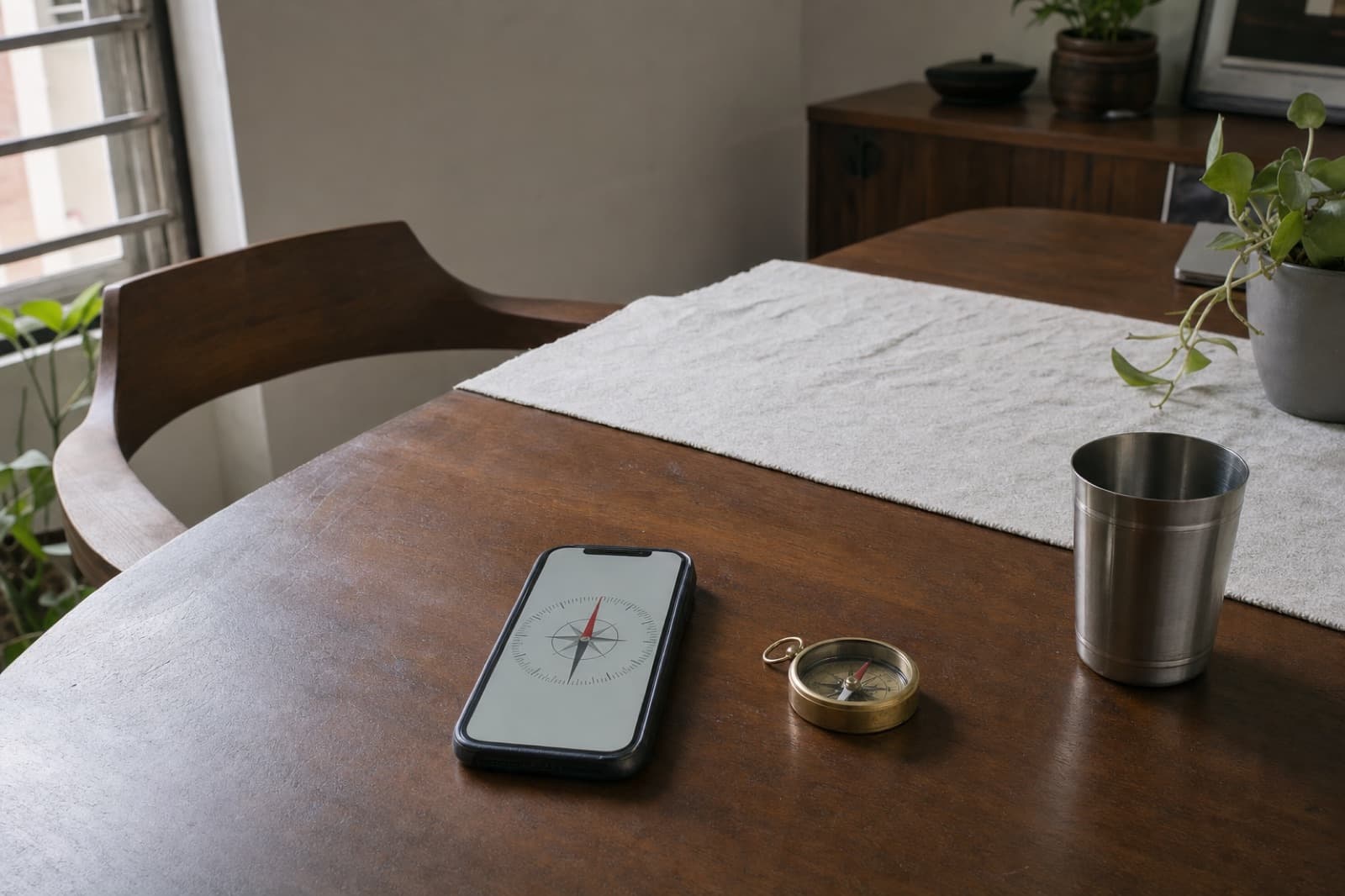
Open the Vastu16 compass or any compass app on your phone. Remove a magnetic phone case or a car-mount plate stuck to the phone. Put keys, coins and a smartwatch charger in a bag on the far side of the room.
Calibrate before the first reading. Android's developer guidance suggests moving the phone in a figure-8 [3]. iPhones show a calibration prompt when they need one [4]. Do this away from metal, because Apple notes that calibration only removes fields that move with the phone. A steel almirah next to you is still there after calibrating [4].
Look around each spot before you stand on it. Columns and beams in an RCC flat contain steel reinforcement, which disturbs phone magnetometers [5]. So do railings, safety grilles, steel door frames, fridges, washing machines, inverters and wiring runs. Note anything metal within a metre or two.
Where to stand: door, centre, balcony
Zones in Vastu are measured from the centre of the home [6], so the centre is the natural place to start. North itself is the same at every spot in the flat. The point of three readings is to show whether metal near one spot is pulling the compass.
Door. Stand one step inside the main door, not on the threshold, with your back to the corridor. Lift shafts and steel door frames sit close to many flat entrances, so move a little into the room if the needle swings.
Centre. Find the middle of the flat by eye from the plan, then shift to the nearest spot that is a metre from any column, table or fan regulator. A dining table with a steel frame counts.
Balcony or far wall. Stand a metre in from the wall opposite the door, or a metre inside the balcony door. Do not lean on a railing or a grille. A balcony reading taken against steel is the most common bad reading.
Reading the bearing and writing it down
Hold the phone flat, screen up, at waist height, with its top edge pointing where you want to measure. To find which way the flat faces, stand inside the main door and point the top of the phone straight out through it. To read a wall's direction, hold the phone with its long side parallel to the wall.
Wait two or three seconds for the number to settle, then write it down in whole degrees. Fill in a form like this one on paper or in your phone's notes:
| Spot | Bearing (degrees) | Metal within 1 to 2 m | Keep or discard |
|---|---|---|---|
| Inside main door | |||
| Centre of flat | |||
| Balcony or far wall | |||
| Extra reading, if needed |
A phone compass shows magnetic North [3]. In Mumbai, Delhi and Bengaluru, magnetic and true North differ by about 1.3 degrees or less, which rarely changes a zone [1]. If you are using these steps outside India, check the local declination first.
When the readings disagree
Compare the three numbers. Vastu16's method rejects compass readings more than 10 degrees apart [6]. If one reading is more than 10 degrees from the other two, mark it "discard", move a step away from whatever metal you noted, and take an extra reading.
If all three disagree with each other, something in the flat is disturbing every spot. That happens in flats with heavy steel framing or large appliances. Do not average three bad readings. Use a satellite map match as your main reference, as our guide to finding North explains, and treat the compass as a rough check.
Small differences of a few degrees between spots are normal indoors. Separately, NOAA notes that the local field can differ from its model by 3 to 4 degrees in many places [2], so even clean readings can sit a few degrees off a satellite map. When two or three readings agree within 10 degrees, average them and use that number.
Turning the reading into zones
The 16-zone school splits the circle into 16 zones of 22.5 degrees, with North centred on 0 degrees [6]. The traditional 8-direction school uses 8 directions of 45 degrees, also centred on North [6].
| 16-zone school | Bearing range | 16-zone school | Bearing range |
|---|---|---|---|
| N | 348.75 to 11.25 | S | 168.75 to 191.25 |
| NNE | 11.25 to 33.75 | SSW | 191.25 to 213.75 |
| NE | 33.75 to 56.25 | SW | 213.75 to 236.25 |
| ENE | 56.25 to 78.75 | WSW | 236.25 to 258.75 |
| E | 78.75 to 101.25 | W | 258.75 to 281.25 |
| ESE | 101.25 to 123.75 | WNW | 281.25 to 303.75 |
| SE | 123.75 to 146.25 | NW | 303.75 to 326.25 |
| SSE | 146.25 to 168.75 | NNW | 326.25 to 348.75 |
In the 8-direction school, North runs from 337.5 to 22.5 degrees, North-east from 22.5 to 67.5, and so on round the circle in 45 degree steps [6]. A door reading of 90 degrees sits in the East zone under both schools, and both rate an East entrance as good [6]. A reading within 5 degrees of a zone line is borderline, and Vastu16 flags it [6]. Our post on how to know the facing of a flat covers the facing question in detail.
Checklist
Five-minute field protocol
- Remove the phone case magnet. Empty your pockets of metal.
- Calibrate with a figure-8 motion, away from metal.
- Reading 1: one step inside the main door, phone pointing straight out.
- Reading 2: centre of the flat, a metre from columns and furniture.
- Reading 3: a metre in from the far wall or balcony door.
- Write each number and any metal nearby in the form.
- Discard any reading more than 10 degrees from the others. Retake it.
- Average the readings that agree and look up the zone.
- If nothing agrees, rely on a satellite map instead.
Add these steps to your Vastu checklist before buying a flat so the readings happen on the first visit.
What is tradition and what is fact
Where Vastu16 fits
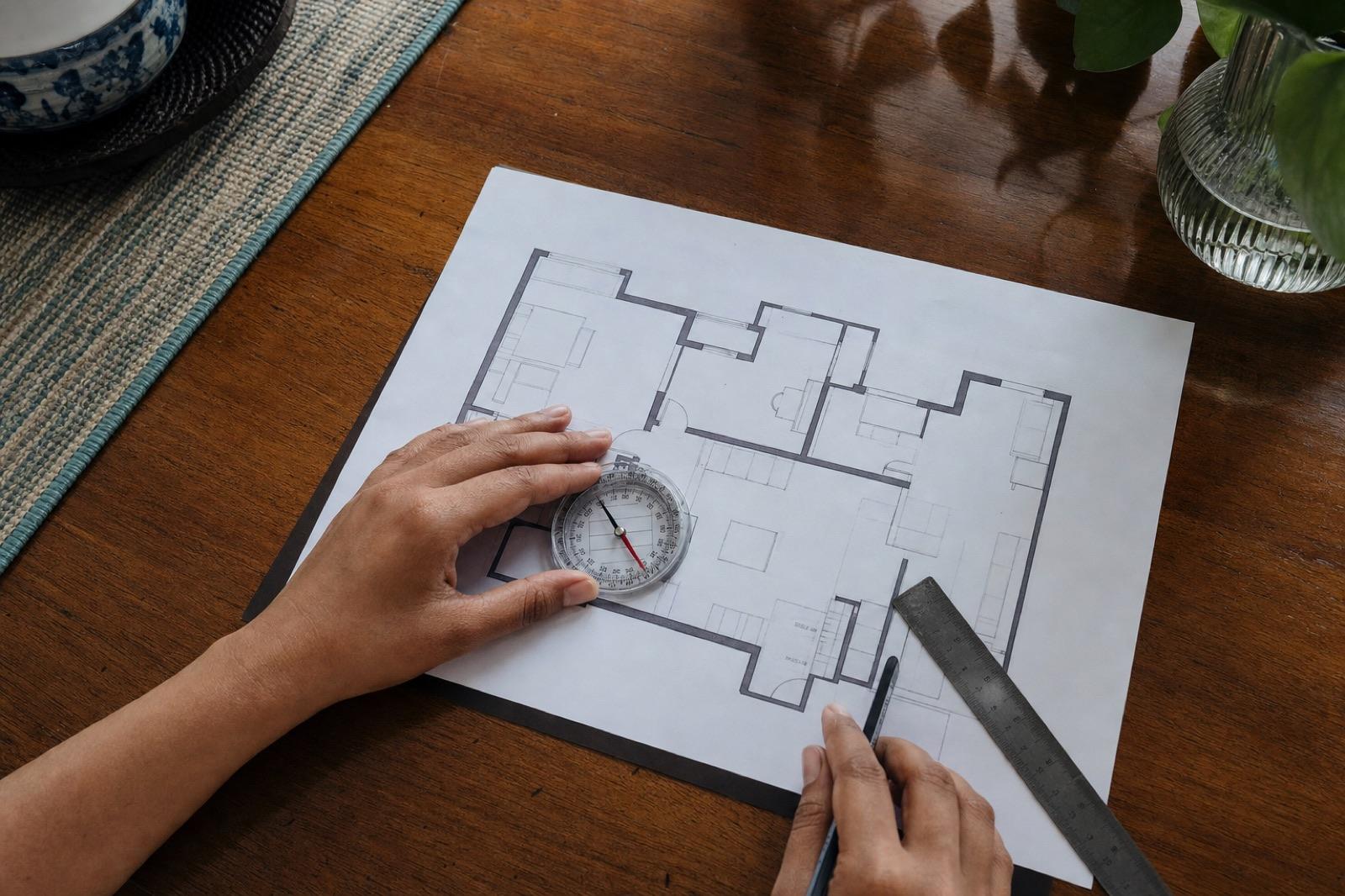
Vastu16 turns these readings into a full reading of the plan. You can check your floor plan under both schools for free: it takes your compass readings, compares them with a satellite map match, rates how far North can be trusted and then places every room in a zone. It cannot tell which of your readings sat next to a column, so the form matters. For the rules that apply to flats, see our page on Vastu for flats.
Questions people ask
Where should I stand to check Vastu direction with a compass?
Take readings in three places: just inside the main door, at the centre of the flat, and near the far wall or balcony door. Stand at least a metre from columns, steel almirahs, the fridge and railings. Zones are measured from the centre of the home, so start there. North is the same at every spot in the flat, so the three readings are there to show whether something nearby is disturbing one of them.
How many compass readings should I take?
Take at least three, in different spots, and write each one down. If one reading is more than 10 degrees away from the other two, discard it and take another a step away. Average the readings that agree. One reading on its own cannot tell you whether a column or an appliance pulled the compass off.
Can I take the reading from the balcony?
You can, but stand back from the railing. Steel railings and grilles disturb a phone compass, so a reading taken while leaning on them is unreliable. Step a metre inside the balcony door, or stand in the middle of a wide balcony, and treat that reading as one of your three, not as the only one.
Related posts
Is a phone compass accurate enough for Vastu?
Phone compasses drift near steel, wiring and RCC. How far off they can be, how to calibrate, and how to cross-check a reading in a flat.
How to know the facing of a flat: door, balcony or tower?
Brokers say east facing, the plan says otherwise. Three definitions of a flat's facing, which one Vastu uses, and how to measure yours.
Vastu checklist before buying a flat: 20 site checks
A 20-point Vastu checklist for the site visit: North, entrance, kitchen, toilets, balcony, light and the documents to ask the builder for.
Sources
- World Magnetic Model (WMM) product page
- WMM Accuracy, Limitations, and Error Model
- Android Developers: Position sensors
- Apple Developer: CLHeading and related Core Location pages
- Sensors (Basel) 2023: Improving Indoor Pedestrian Dead Reckoning for Smartphones under Magnetic Interference Using Deep Learning
- Vastu16 methodology and rule table (internal)