 Vastu16
Is a phone compass accurate enough for Vastu?
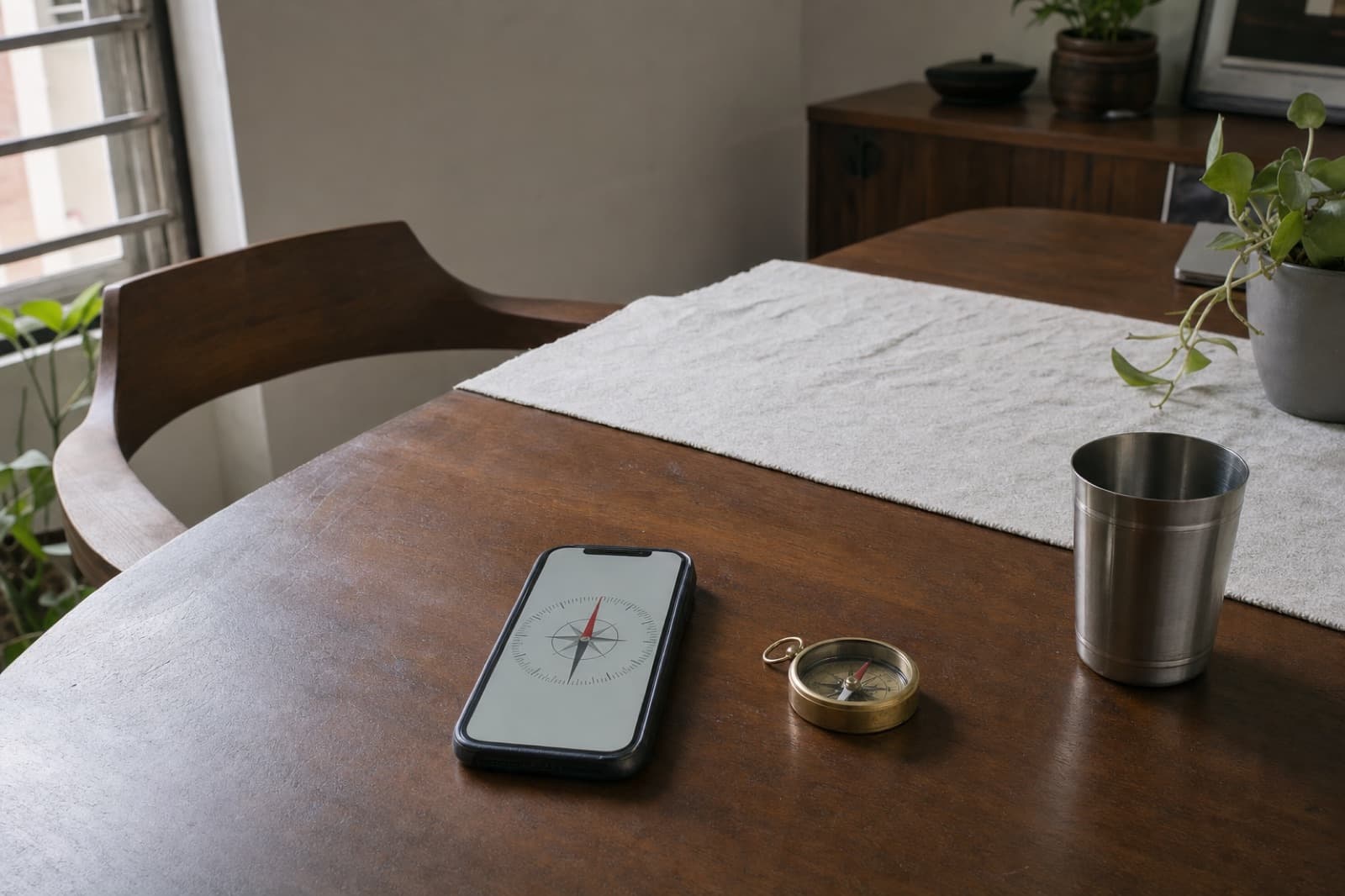
Next: your whole home. Rules are general. Your plan is specific. Upload it and see where each room of your home falls under both schools.
The short answer
Yes, if you calibrate it, hold it flat away from steel and confirm it a second way. A phone compass shows magnetic North, and steel reinforcement, wiring and appliances pull it off indoors by amounts no published source pins down for flats. Take three readings, drop the outlier, and compare with a satellite map before trusting a zone.
Is a mobile compass accurate for Vastu, then? Accurate enough as one of two checks, not as the only one. Vastu16 treats the phone as a cross-check on a satellite map match for exactly this reason. The rest of this guide explains what the phone measures, what disturbs it and how much error each Vastu school can absorb.
How does a phone compass work?
A phone carries a magnetometer that measures the magnetic field on three axes, in microtesla. Combined with the accelerometer, it gives the phone's heading relative to magnetic North [4]. Android documents that this heading is an angle from magnetic North, not true North [4].
To show true North, the phone must add a correction from a model of the Earth's field. Android's GeomagneticField class uses the World Magnetic Model to compute declination for a place and date [5]. On iPhones, Core Location reports both a magnetic heading and a true heading, and the true heading needs the device's location [6]. Whether a given Vastu app shows magnetic or true North depends on how it was built, so check its settings. Our comparison of online Vastu check tools notes how each one sets North.
iPhones also report a heading accuracy: the maximum error in degrees. A negative value means the heading is invalid, which Apple says can happen when the device is uncalibrated or near strong local magnetic fields [6]. If your app shows an accuracy figure, read it before the heading.
What throws a phone compass off indoors?
The Earth's field at the surface is weak, roughly 25,000 to 65,000 nanotesla [3]. Anything magnetic close to the phone competes with it.
Buildings are full of such things. A 2023 study on indoor navigation lists electronic devices and steel reinforcement within buildings as sources of magnetometer disturbance [8]. An earlier study tested phones in homes, a library and offices and found the magnetometer sensitive to magnetic noise, especially indoors [7]. Neither study measured a phone lying flat on a floor plan, so neither gives an error figure you can apply to a flat.
The ground itself adds a little. NOAA's model covers only the Earth's core field. Local anomalies of 3 to 4 degrees are not uncommon, though usually small in extent, and anomalies over 10 degrees are rare [2].
Phones also carry their own bias. Android exposes an "uncalibrated" magnetometer because hard-iron calibration can make readings jump [4]. Steel almirahs, fridges, railings, columns and even a phone case magnet all matter.
Calibrating and taking three readings
Calibration removes the phone's own bias. Android's guidance suggests waving the device in a figure-8 [4]. iPhones prompt for calibration when needed [6]. Apple adds an important limit: calibration can only filter fields that move with the device, so to deal with other magnetic sources you have to move away from them [6].
After calibrating, take three readings rather than one:
| Spot | Where to stand | Watch for |
|---|---|---|
| Door | Just inside the main door, facing out | Steel door frames and safety grilles |
| Centre | The middle of the flat, away from walls | Ceiling fans, wiring runs, the dining table |
| Far wall | A metre in from the wall opposite the door | Columns, almirahs, the fridge |
Vastu16's method rejects compass readings more than 10 degrees apart [9]. If one of the three disagrees with the other two by more than that, discard it and take another reading a step away. If all three disagree, something in the flat is disturbing them all, and the map becomes your main reference.
Cross-checking with a satellite map
A satellite map is not affected by steel. Google's documentation defines the map's bearing from true North, with a bearing of 0 meaning the top of the map points to true North [10]. Our post on finding North with Google Maps gives the steps.
A map gives true North and a compass gives magnetic North, so the two should differ by the local declination. In Mumbai that is about 0 degrees, in Delhi about 1.3 degrees east and in Bengaluru about 1.1 degrees west [1]. In those cities, a map and a compass that disagree by more than a few degrees point to interference, not declination. In the USA the gap can reach 12 to 15 degrees, which our post on magnetic North versus true North explains.
Vastu16 rates North as High confidence when the map match and the compass agree within 8 degrees, Medium between 8 and 15 degrees, and Low beyond that [9]. The guide to finding North sets out all three methods.
How much error can a 16-zone reading tolerate?
The 16-zone school divides the home into zones of 22.5 degrees, and the traditional 8-direction school uses 45 degrees [9]. How much error you can absorb depends on where a room sits within its zone.
| Error in North | 16-zone school (22.5 degree zones) | 8-direction school (45 degree zones) |
|---|---|---|
| Under 5 degrees | Changes only rooms within 5 degrees of a zone line | Same, but lines are half as frequent |
| 5 to 11 degrees | Can move rooms in the outer part of a zone | Changes only rooms near a line |
| Over 11.25 degrees | Can move any room, even one centred in its zone | Changes rooms in the outer part of a zone |
| Over 22.5 degrees | A whole zone off | Can move any room |
The 16-zone school is about twice as sensitive as the 8-direction school. Vastu16 flags any room within 5 degrees of a zone line, because a small error in North would change its reading [9].
Checklist
Reading protocol for a phone compass
- Take off a magnetic phone case. Empty your pockets of keys and coins.
- Calibrate with a figure-8 motion, standing away from metal.
- Hold the phone flat, screen up, at waist height.
- Stand at least a metre from columns, almirahs, the fridge and railings.
- Read at the door, the centre and the far wall. Write down all three.
- Discard any reading more than 10 degrees from the other two. Retake it a step away.
- Compare the average with the bearing from a satellite map.
- If they differ by more than 8 degrees, trust the map and note the gap.
What is tradition and what is fact
Tradition
- The 16-zone school reads 16 zones of 22.5 degrees from North, and the traditional 8-direction school reads 8 directions of 45 degrees [9].
- The classical texts found directions from the sun's shadow, which gives true directions, not magnetic ones (Mayamata ch. 6) [11].
Physical fact
- Phone headings are relative to magnetic North unless the app applies a model correction [4][5][6].
- Steel reinforcement and electronics disturb indoor magnetometer readings [7][8].
- Local magnetic anomalies of 3 to 4 degrees are not uncommon [2].
- Declination in Mumbai, Delhi and Bengaluru is within about 1.5 degrees [1].
Where Vastu16 fits
The Vastu16 compass shows your phone's heading and its zone under both schools, using magnetic North. The full check goes further. You can check your floor plan under both schools for free: it asks for a satellite map match, takes your compass readings, compares the two and rates North before any zone is read. It cannot see the steel in your walls, so it relies on that comparison. The rules for both are on the methodology page.
Questions people ask
Is a mobile compass accurate for Vastu?
It can be, with care. A calibrated phone held flat, a metre or more from steel, gives a usable magnetic reading. Indoors, steel reinforcement, wiring and appliances can pull it off by amounts that vary from spot to spot. Take three readings in different places, discard any outlier, and confirm the result against a satellite map before trusting a zone.
Why does my compass show different readings in different rooms?
Because the phone senses every magnetic field near it, not only the Earth's. Steel in columns, beams, railings and almirahs, and current in wiring and appliances, add local fields that change from room to room. The Earth's field is weak, so a nearby steel object can shift the reading noticeably. Readings that disagree by more than 10 degrees should be retaken elsewhere.
How do I calibrate my phone compass?
Move the phone in a figure-8 motion a few times, as Android's developer guidance suggests, or follow the calibration prompt on an iPhone. Do it away from metal: Apple notes that calibration only removes fields that move with the phone, so a nearby steel almirah or fridge still distorts the reading after calibration.
Related posts
Magnetic North vs true North in Vastu: which to use
A compass points to magnetic North, maps to true North. The difference by city, when it changes a Vastu zone, and which one Vastu16 uses.
How to find North with Google Maps for a Vastu check
Satellite maps show true North at the top. How to line up your building on the map, read its angle, and use it to check a floor plan.
How to take a compass reading in a flat for Vastu
Where to stand, how to hold the phone and how many readings to take in a flat, plus the RCC and steel traps that throw readings off.

Sources
- World Magnetic Model (WMM) product page
- WMM Accuracy, Limitations, and Error Model
- NOAA NCEI Geomagnetism FAQ
- Android Developers: Position sensors
- Android API reference: GeomagneticField
- Apple Developer: CLHeading and related Core Location pages
- Mohssen et al., "It's the Human that Matters: Accurate User Orientation Estimation for Mobile Computing Applications" (arXiv:1411.2156, 2014)
- Sensors (Basel) 2023: Improving Indoor Pedestrian Dead Reckoning for Smartphones under Magnetic Interference Using Deep Learning
- Vastu16 methodology and rule table (internal)
- Google Maps Platform: Vector Map Features (tilt, heading and camera bearing)
- Mayamata (Dagens critical edition and English translation), Vol. I