 Vastu16
12 Vastu questions to ask the builder before booking

12 questions, asked before the token, get you the three things a Vastu check needs: the sanctioned plan, the plan of your exact unit, and a North reference you can verify. These are the questions to ask the builder about Vastu, with what to ask for in writing and what a good answer sounds like.
At Vastu16 we check a flat from its floor plan and North under two schools, the 16-zone school and the traditional 8-direction school. Which rooms matter most in a flat is covered on our Vastu for a flat page. This post is for the meeting with the sales team.
Next: your whole home. Rules are general. Your plan is specific. Upload it and see where each room of your home falls under both schools.
Why ask before the token
Your bargaining position is strongest before money changes hands. Under the RERA Act 2016, a promoter cannot take more than 10 percent of the cost as an advance or application fee without first signing and registering a written agreement for sale (s. 13(1)) [1]. Ask your questions before that agreement, while you can still choose a different unit.
The Act also gives you a right to the documents. The promoter must make the sanctioned plans, layout plans and specifications available at booking and allotment (s. 11(3)(a)), and an allottee is entitled to that information (s. 19(1)) [1]. Asking for them is normal, not awkward.
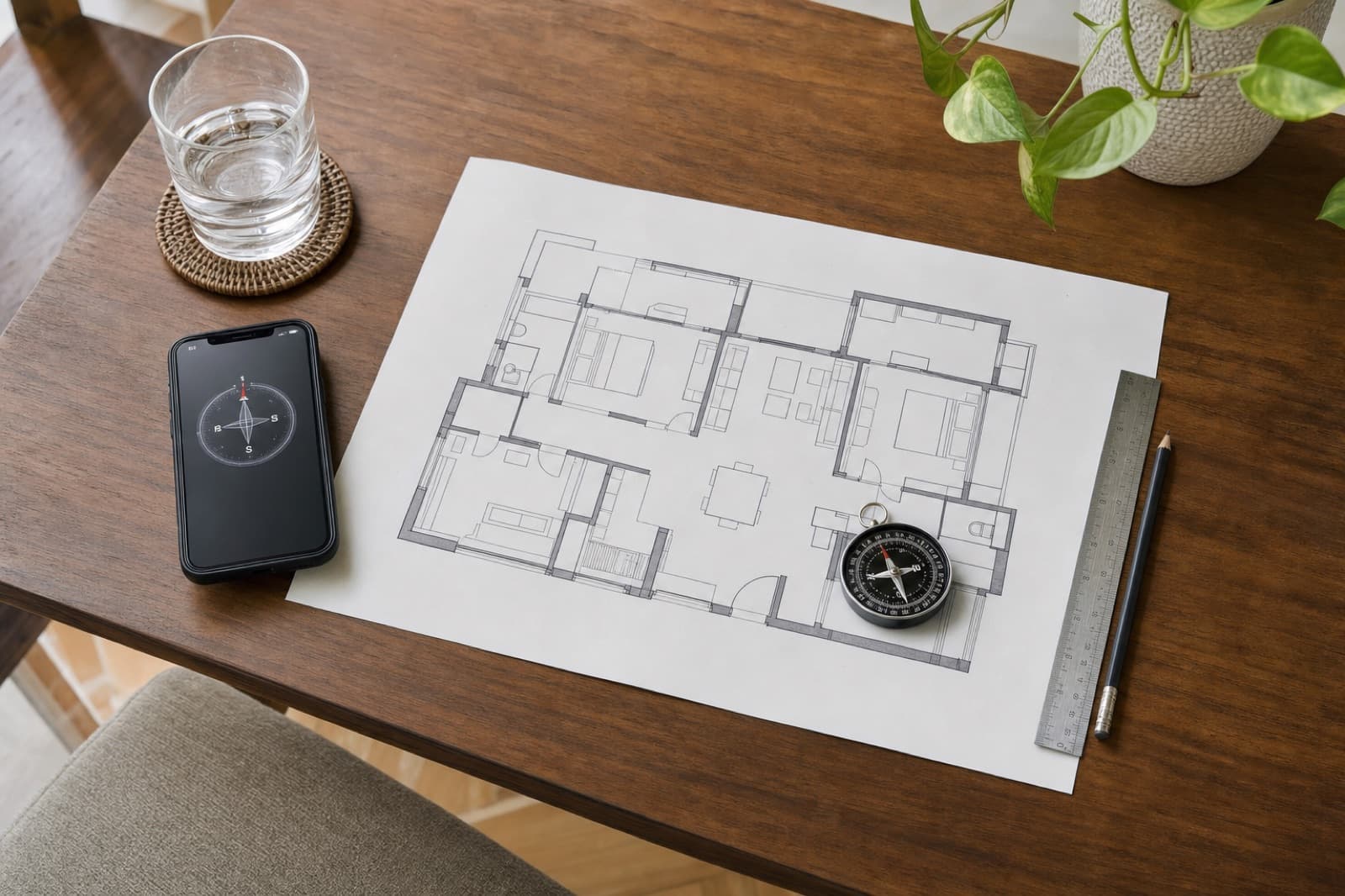
Two things to know before you walk in. Brochure plans often show a typical unit, and units in one tower are often mirror images. And brochure North arrows are often approximate; our post on the brochure North arrow shows why.
This is general information, not legal advice. Check your state's RERA rules or ask a lawyer.
Questions to ask the builder about Vastu: plan and North
1. May I have a copy of the sanctioned plans, the layout plan and the specifications? These are the approved drawings, not the marketing plan. The Act requires them to be made available at booking, by display at the site or as the state's regulations specify (s. 11(3)(a)) [1].
2. What is the project's RERA registration number? Advertisements must carry it (s. 11(2)) [1]. Look the project up on your state portal; MahaRERA, for example, offers a public search of registered projects [3].
3. Where is true North on the site layout plan, and how was it drawn? You want to know whether the arrow came from a survey or was added by the designer. Then check it yourself; our guide on how to find North for Vastu uses a satellite map match.
4. When you say "Vastu compliant", what does that mean for my unit? We found no statute, regulation or standard that defines or certifies the label. Ask which rooms it refers to. Our post on what a Vastu compliant flat means covers the label.
Questions about your exact unit
5. Which plan is my unit, by unit number? Is the model flat built to that plan? A mirror-image unit puts the same rooms in different zones. Section 12 of the Act gives compensation to a buyer who pays an advance on the basis of an advertisement or a model apartment and suffers a loss because of a false statement in it [1].
6. Where exactly is my main door, and which side of the corridor is it on? The door zone is one of the readings that matters most. In Vastu16's rule table, both schools rate a south-west main door 4 of 5 [4].
7. Where is every toilet, and where are the plumbing shafts? Toilet positions follow the shafts, so they are the hardest thing to change later. Both schools rate a toilet in the north-east or at the centre 5 of 5 [4].
8. Where will the hob, sink and kitchen window be? The hob position inside the kitchen is easier to discuss before the platform is built.
9. What is the carpet area and the exclusive balcony area of my unit? The Act defines carpet area in s. 2(k), and the promoter files the carpet area and balcony area of each apartment with the authority (s. 4(2)(h)) [1]. In Gurugram, the regulator has said sale must be on carpet area, not super area [2].
Questions about changes before possession
10. Which changes inside my unit do you allow, and until what construction stage? Get the answer and the deadline in writing.
11. If the plan of my unit or building changes, how will you tell me? After the plans are disclosed to you, the promoter cannot make additions or alterations to your unit's sanctioned plan without your previous consent, apart from minor changes for architectural or structural reasons that an architect or engineer verifies and you are told about (s. 14(2)(i)). Other changes to the building's plans need the written consent of at least two-thirds of allottees (s. 14(2)(ii)) [1].
12. Will any change we agree be written into the agreement for sale? The agreement must specify the particulars of the apartment and its specifications (s. 13(2)) [1]. A verbal promise is not enough.
Checklist
What good and weak answers sound like
Copy this list to your phone, and tick each box.
| # | Ask for, in writing | Good answer | Weak answer |
|---|---|---|---|
| 1 | Sanctioned plans and layout plan | A copy, or a link on the RERA portal | "Only the brochure is available" |
| 2 | RERA registration number | A number you can look up | "Registration is in process" |
| 3 | North on the site layout | Points to the survey drawing | "North is roughly up" |
| 4 | Basis of "Vastu compliant" | Names the rooms and zones | "The whole project is Vastu" |
| 5 | Unit plan by unit number | Your unit's own drawing | "All 2 BHKs are the same" |
| 6 | Main door position | Marked on your unit plan | "Standard entrance" |
| 7 | Toilets and shafts | Shown on the plan | "Will be finalised later" |
| 8 | Hob, sink, kitchen window | Marked, with options | "Standard kitchen" |
| 9 | Carpet and balcony area | Figures per s. 2(k) | Super area only |
| 10 | Allowed changes and deadline | A written list with a date | "Talk to us later" |
| 11 | How plan changes are notified | A written process | "Changes rarely happen" |
| 12 | Changes in the agreement | Added as a clause | "Our word is enough" |
A weak answer is not proof of bad faith. It is a reason to ask again in writing, and to check the RERA portal yourself. Our checklist before buying a flat covers what to look at on the visit itself.
What is tradition and what is fact
Tradition
- Zone readings for the door, toilets and kitchen: Vastu16's rule table, under the 16-zone and 8-direction schools.
- A south-west main door, 4 of 5 in both schools; a north-east or central toilet, 5 of 5 in both.
Physical and legal fact
- Sanctioned plans available at booking: RERA Act 2016, s. 11(3)(a). Right to the information: s. 19(1).
- Advance capped at 10 percent without a registered agreement: s. 13(1).
- No change to your unit's sanctioned plan without your consent; two-thirds of allottees for other changes: s. 14(2).
- Compensation for a false statement in an advertisement or model flat: s. 12.
- No certifying body for "Vastu compliant" was found.
Where Vastu16 fits
Once you have your unit's plan, you can check the unit plan under both schools and verify North in a few minutes. The tool shows each room's zone, its reading in each school and the severity; our sample report shows what you get. It does not read sanctioned plans for legality or confirm what a builder promised. For a reviewed opinion on a specific unit, you can consult our Vastu experts.
Questions people ask
What should I ask a builder about Vastu?
Ask for three things first: the sanctioned plans and layout plan, the plan of your exact unit by unit number, and where true North is on the site layout and how it was drawn. Then ask where the door, toilets and hob sit in your unit, and which changes are allowed before possession.
Can I get the sanctioned floor plan before booking?
Under the RERA Act 2016, the promoter must make the sanctioned plans, layout plans and specifications available at booking and allotment (s. 11(3)(a)), and an allottee is entitled to that information (s. 19(1)). Ask for a copy before you pay a token, and check the project on your state's RERA portal.
Should the builder tell me where North is?
Ask, but verify the answer. The North arrow on a brochure is often approximate, and the sections of the RERA Act we read do not require the builder to state it. Ask which document the arrow comes from, then match the tower on a satellite map yourself. A wrong North can move every room into a different zone.
Related posts
What 'Vastu compliant' means when a builder says it
What is Vastu compliant? We found no body that certifies the label. What it can mean, what to ask the builder, and how to check it yourself in 10 minutes.
Is the brochure's North arrow right? How to check it
How to check the Vastu direction of a flat: test the brochure's North arrow against a satellite map, a compass and the sanctioned plan.
Vastu checklist before buying a flat: 20 site checks
A 20-point Vastu checklist for the site visit: North, entrance, kitchen, toilets, balcony, light and the documents to ask the builder for.
Sources
- The Real Estate (Regulation and Development) Act, 2016 (No. 16 of 2016), Gazette of India Extraordinary text
- Haryana RERA Gurugram: Sale of Apartments/Floors in a Real Estate Project on the basis of Carpet Area Regulations, 2021 (Haryana Government Gazette, 18 May 2021)
- MahaRERA portal home page
- Vastu16 methodology and rule table (internal)