 Vastu16
T-junction house in Vastu: roads that end at your plot
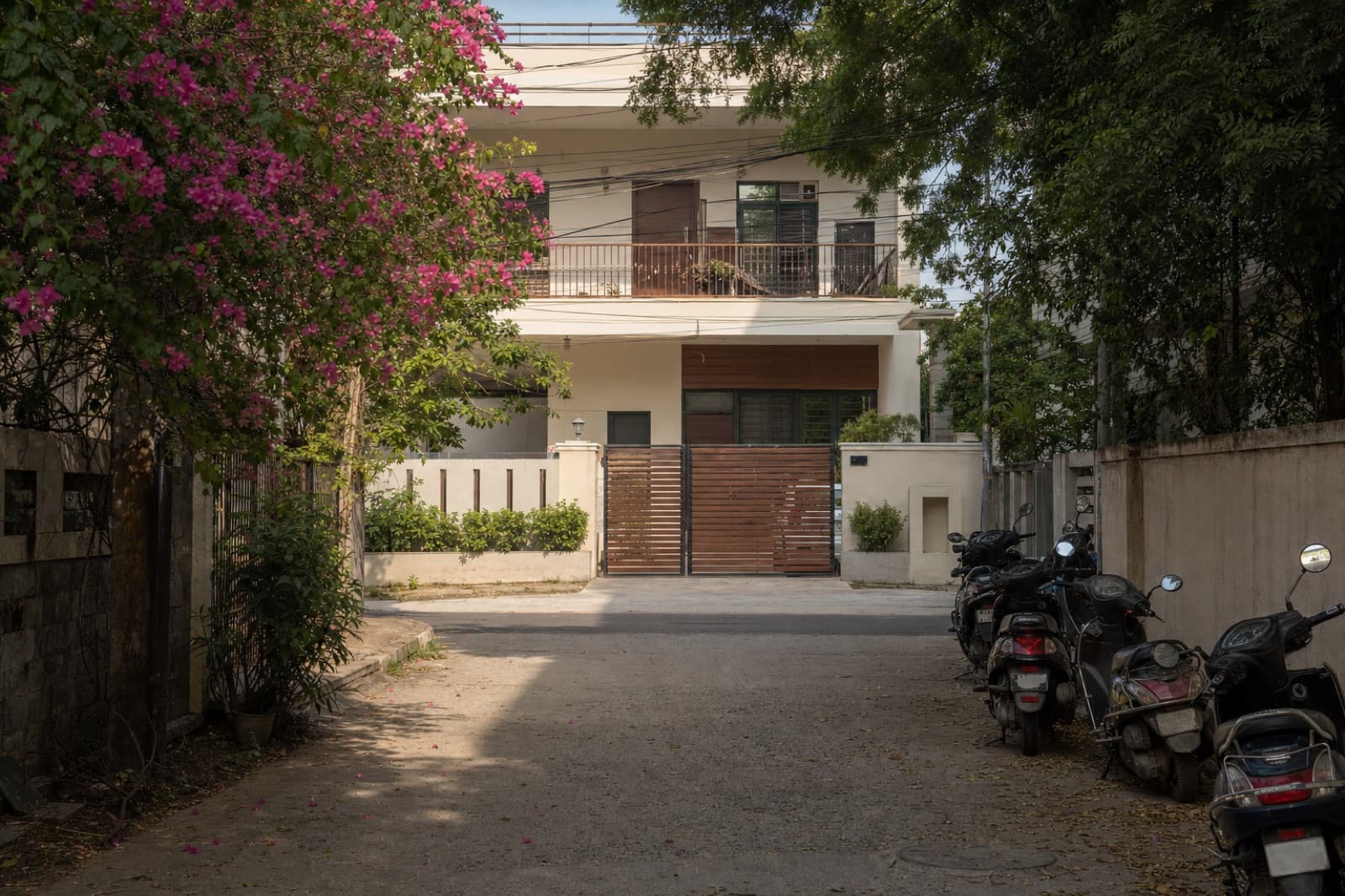
Seven of sixteen road directions are read as favourable by one practitioner, so a T-junction plot is not automatically a problem. In T junction house Vastu, a road ending at a plot is called veedhi shoola, and practitioners read it by direction. Vastu16's check does not score it. Traffic, headlights and noise are the physical side, and design handles them.
If someone told you the plot you like is bad because a road ends at it, you are hearing one strand of practitioner belief. At Vastu16 we separate what tradition says, what practitioners add, and what you can measure on site. This post covers all three, with design options ranked from simplest to biggest.
Next: your whole home. Rules are general. Your plan is specific. Upload it and see where each room of your home falls under both schools.
T-junction house Vastu: the short answer
Vastu16's check does not score road position or T-junctions. What follows is practitioner guidance and classical text, not a rule from our table.
- The classical texts are wary of roads at a site. The Mayamata rejects sites crossed by roads (ch. 3, vv.10b-19) [3]. The Manasara lists a site at a junction of paths among those to avoid (IV.27) [4]. The Brihat Samhita counts a door struck by a road as a fault (53.76-78) [5].
- Practitioners read a road ending at a plot by its direction. Most treat roads from the north and east as favourable and roads from the south-west as unfavourable, but they disagree on several directions [1][2].
- The physical side is traffic aimed at your gate, headlights at night and road noise. Those are worth checking at any plot, with or without Vastu.
What veedhi shoola is
Veedhi shoola is a road that runs straight at a plot and ends there, the stem of a T meeting your boundary. One practitioner glosses veedhi as road and shoola as a bolt or spike [2]. Another describes the plot as overexposed to traffic, air and noise [1]. A road hitting house Vastu question is the same thing in plainer words.
A dead end road house is a different case. On a dead end, the road stops short of your plot or runs past it into a cul-de-sac. On a T-junction, the road points at you. Practitioner pages discuss the second; one advises against dead-end plots as well, without a textual source [1].
The texts we read do not use the term veedhi shoola. Their closest rules are about sites crossed by roads, sites at junctions, and doors struck by roads [3][4][5]. The modern direction-by-direction readings come from practitioners. Our Vastu glossary defines the classical terms that do appear in the texts.
Readings by direction
"A road from the north" means the road approaches from the north and ends at the plot's north side. The table compares two practitioner pages. Both are commercial consultancies and describe belief only; we do not repeat the outcomes they attach to each direction.
| Road comes from | AppliedVastu [1] | Maha Vastu Shastra [2] |
|---|---|---|
| North, NNE | Favourable | NNE favourable |
| North-east, ENE | Favourable | ENE favourable |
| East | Favourable | Not stated |
| South-east | Unfavourable | Favourable |
| SSE | Favourable | Not stated |
| South, SSW | Unfavourable | SSW unfavourable |
| South-west, WSW | Unfavourable | Unfavourable |
| North-west | Unfavourable | Not stated |
| WNW | Favourable | Favourable |
| NNW | Unfavourable | Unfavourable |
The two agree on the north and east side and on the south-west side. They disagree on the south-east. Neither cites a classical verse for its readings. AppliedVastu also says the effect is believed to fall mainly on ground-floor units [1]. Treat the table as a record of belief, and expect a third consultant to differ again.
The physical side: traffic, noise, headlights
The parts of a T-junction you can observe are not mysterious.
Traffic. Every vehicle on the stem road drives towards your boundary before it turns. Check whether there is a kerb, footpath or wall between the road end and your gate, and how fast cars arrive.
Headlights. At night, cars on the stem road point their lights at the plot. Front rooms in line with the road get swept by light every time a car arrives.
Noise. Cars slow, brake, turn and sometimes honk at a junction. WHO guidance recommends road traffic noise under 53 dB averaged over day, evening and night, and under 45 dB at night [6]. You cannot measure decibels by ear, but you can tell whether a bedroom would face the junction.
These matter at any junction plot, whatever your view of Vastu. They also explain why many owners prefer a gate that is not directly in line with the road, which both practitioner pages advise [1][2].
Design options: gate, boundary, landscaping
Ranked from free to bigger. None of these needs a product, mirror or metal strip.
- Offset the gate. Do not put the gate or the main door directly in line with the road. Both practitioner pages advise this [1][2], and it also keeps headlights off the door. On a narrow frontage, such as a 30x40 north facing plot, moving the gate a few feet along the boundary is often enough.
- Put bedrooms on the quiet side. WHO guidance on road noise lists designing a quiet side in the dwelling as one action [6]. Place living, parking or a study towards the road end and bedrooms away from it.
- Build a solid boundary wall at the road end. Practitioners advise a thicker or higher wall facing the road [1][2]. A solid wall is also a barrier, which WHO lists as a path intervention for road noise [6].
- Plant a hedge or trees. One practitioner advises a hedge or tall trees, especially for a road from the south or south-west [1]. Planting also screens headlights.
- At plan stage, shift the main door. Vastu16's remedy list for entrances suggests moving the door along the same wall into the neighbouring zone while the home is still being built [7].
For a detached house with open sides, our villa and independent house page covers the room reading once the gate and door are fixed.
Checklist
On your site visit
- Note the direction the road comes from. Stand at the end of the stem road, look at the plot, and note the compass direction behind you.
- Note the road's width and speed. A lane with parked cars is different from a through road.
- Visit after dark. Watch where headlights fall. Listen from where the bedrooms would be.
- Check the gap. Is there a footpath, kerb or wall between the road end and the plot?
- Plan the gate and door. Sketch a gate position that is offset from the road's line.
- Read the plot and the plan separately. The plot's road side and the house's door can face different ways, as explained in plot facing vs house facing.
For the wider choice of plot, see the best direction for a plot. For other widely repeated rules that do not hold up, see Vastu myths, checked against the texts.
What is tradition and what is fact
Tradition
- Sites crossed by roads are rejected: Mayamata ch. 3, vv.10b-19 [3].
- Sites at a junction of paths are avoided: Manasara IV.27 [4].
- A door struck by a road is a fault: Brihat Samhita 53.76-78 [5].
- Direction-by-direction readings of veedhi shoola: practitioner belief, which differs between pages [1][2].
Physical fact
Where Vastu16 fits
Once you have a house plan for the plot, you can check the house plan under both schools. The tool reads the main door and every tagged room by zone under the 16-zone and 8-direction schools. It does not score the road, the junction or the gate, and it does not recommend mirrors, strips or other products.
Questions people ask
Is a T-junction house bad as per Vastu?
Not as a rule. Practitioners read a road ending at a plot by the direction it comes from, and most treat roads from the north, north-east and east as favourable. Vastu16's check does not score road position. The physical side is real: traffic heading at the gate, headlights at night and noise, all of which design can reduce.
What is veedhi shoola?
Veedhi shoola is the practitioner term for a road that runs straight into a plot and ends there, as at a T-junction. Veedhi means road and shoola a spike or bolt. The classical texts we read reject sites crossed by roads or at road junctions, and count a door struck by a road as a fault.
Which direction road hit is acceptable?
Practitioner pages most often name roads from the north, north-north-east, north-east, east-north-east and east as favourable, and roads from the south-west side as unfavourable. They disagree on others: one reads a south-east road as favourable, another as unfavourable. These are beliefs, not rules from Vastu16's table.
Related posts
Best direction for a plot as per Vastu: how to choose
Choosing land? How Vastu reads plot facing, roads, shape and slope, what to check on site, and what you can design around later.
Plot facing vs house facing: road side or front door?
The road side of a plot and the direction of the front door can differ. How Vastu treats each and which one to use for your plan.
12 Vastu myths, checked against the texts
South facing homes are bad, a north-east toilet cannot be lived with, cactus is unlucky: 12 popular Vastu myths checked against the texts.
Sources
- AppliedVastu: "T Junction or T point Road Hitting Vastu" (practitioner page)
- Maha Vastu Shastra blog: "Veedhi Shoola Vastu" (practitioner page)
- Mayamata (Dagens critical edition and English translation), Vol. I
- Manasara (Acharya translation, 1934)
- Brihat Samhita of Varahamihira (chapter on house-building)
- WHO Compendium on health and environment, Chapter 11: Environmental noise (2022 update)
- Vastu16 methodology and rule table (internal)