 Vastu16
Are west facing homes hotter? Sun, heat and Vastu
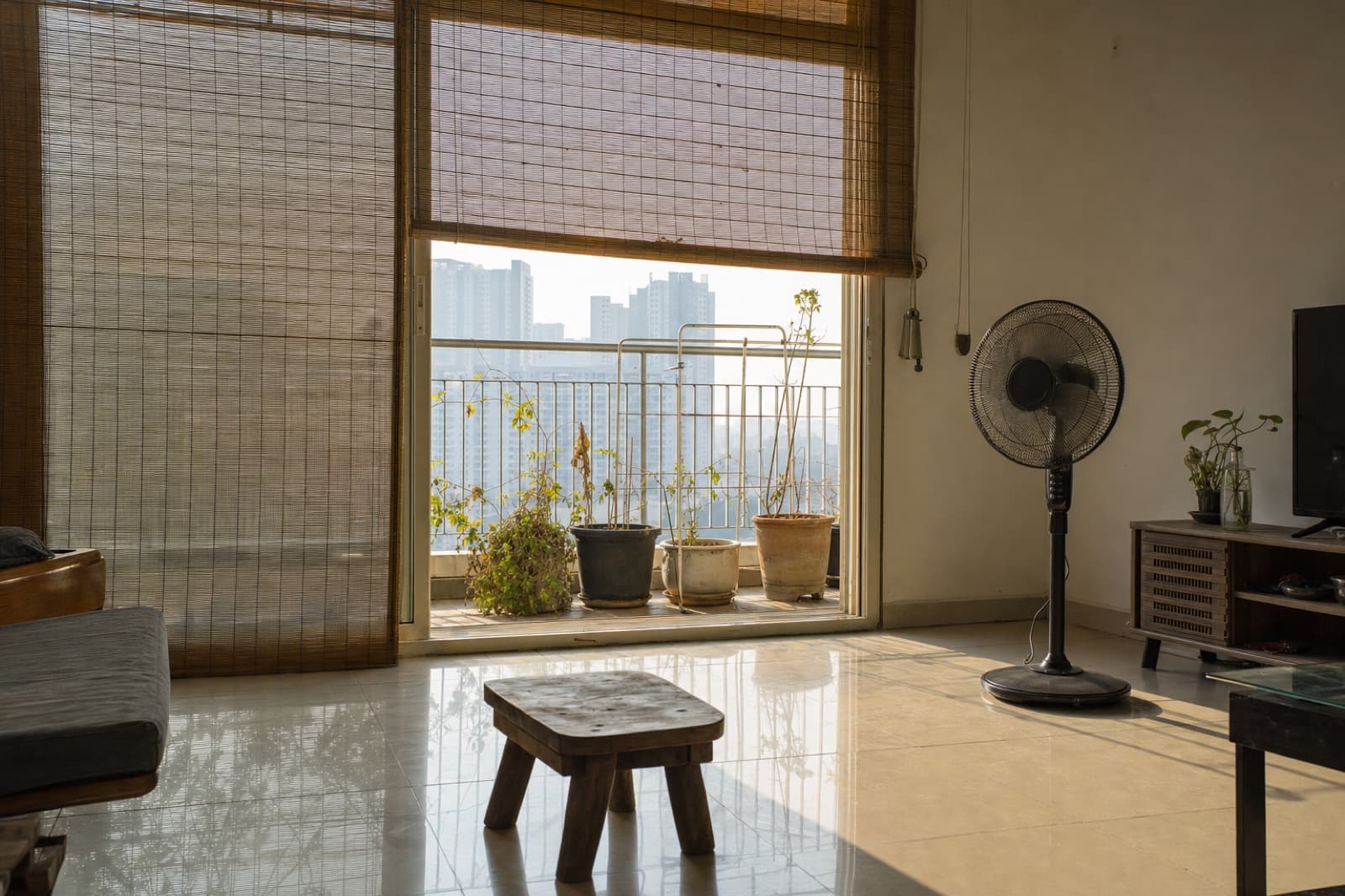
Next: your whole home. Rules are general. Your plan is specific. Upload it and see where each room of your home falls under both schools.
The short answer
Usually, yes: 1.156 is the heat-gain weight India's residential energy code gives west-facing walls south of 23.5 degrees north, the highest of eight orientations, against 0.659 for north. East is almost the same at 1.155. Heat follows where the glass faces and how it is shaded, far more than which way the main door faces.
West facing house heat is a real effect, but it is not the same thing as a west facing door. Vastu16 reads the Vastu side of a west facing home on our page about west facing houses. This post covers the building physics: what the codes say, where they agree with Vastu, and what to change.
The sun's path at Indian latitudes
The National Building Code states the goal for a building in India: the most solar radiation in winter and the least in summer (Part 8, cl. 3.4.1) [3]. Outside the cold zone, it asks for sun-breakers to cut out direct sun and glare (cl. 3.4.1.1) [3].
The code's table of solar radiation on walls, for latitudes from 9 to 29 degrees north, shows a clear pattern. East and west walls receive more radiation in summer than in winter, and the two receive the same daily amount. The south wall is the opposite: far more in winter than in summer [3].
So east and west walls share the summer heat load, and what differs is timing. East glass takes the morning sun and west glass takes the afternoon sun. West rooms take their sun later in the day, which is when many households are at home to feel it.
West glass, heat gain and the energy code
Eco-Niwas Samhita 2024, the Bureau of Energy Efficiency's code for homes, weights each wall by orientation when it calculates heat gain. The code gives one set of weights for latitudes under 23.5 degrees north, which covers Mumbai, Pune, Hyderabad, Bengaluru, Chennai and Kolkata, and another for places further north such as Delhi. Under 23.5 degrees north, the weights are [5]:
| Orientation | Heat-gain weight (ENS 2024, Table 49) | Vastu16 balcony reading, 8-direction school | Vastu16 balcony reading, 16-zone school |
|---|---|---|---|
| North | 0.659 | Good | NNW neutral, N good, NNE good |
| North-east | 0.906 | Good | NNE, NE and ENE good |
| East | 1.155 | Good | ENE good, E good, ESE neutral |
| South-east | 1.125 | Neutral | Neutral in all three zones |
| South | 0.966 | Neutral | Neutral in all three zones |
| South-west | 1.124 | Avoid, 2 of 5 | Neutral in all three zones |
| West | 1.156 | Neutral | Neutral in all three zones |
| North-west | 0.908 | Neutral | Neutral in all three zones |
North of 23.5 degrees the order changes: south-east (1.211) and south-west (1.202) weigh more than west (1.143), and north stays lowest at 0.550 [5]. The same code caps the heat gain through a home's walls and windows, excluding the roof (RETV), at 15 watts per square metre in composite, hot-dry, warm-humid and temperate climates [5]. An IIT Bombay handbook adds that, once orientation is fixed, heat entry is controlled by glazing area and type, wall and roof construction, and shading [6]. Of four layouts it modelled for an air-conditioned block with one fully glazed long wall, the highest annual cooling load in warm climates came with the glass facing south-west. A west-facing glass wall was not one of the four [6].
Where this agrees with Vastu, and where it does not
Vastu16's table rates a balcony on the north, north-east or east as good under both schools, apart from the north-north-west and east-south-east edge zones, which the 16-zone school reads as neutral. The 8-direction school reads a south-west balcony as one to avoid, severity 2 of 5, while the 16-zone school reads it as neutral [7]. Windows are not scored. Building physics agrees on the north, which has the lowest heat-gain weight, and on caution with south-west glass [5][6].
The east is where they part. Both schools praise east openings, but the energy code weights east walls almost exactly like west walls [5]. Morning sun is gentler to live with, but it is not less heat.
The west door itself carries no penalty in our table. A main door in the west zone is neutral under both schools, though the 16-zone school reads the neighbouring west-north-west zone as one to avoid, severity 3 of 5 [7]. The classical texts allow a west door: the Mayamata names the Puspadanta square and the Manasara the Pushpadanta quarter [1][2]. Our post on west facing flat Vastu covers the full reading.
Bedrooms show a third gap. Both schools rate a bedroom in the west as good, except that the 16-zone school reads the west-north-west zone as one to avoid [7], while a west wall takes the afternoon heat.
Shading, glass and layout fixes
Free and low-cost steps come first. Draw thick curtains or blinds on west windows from early afternoon. Keep west windows shut while the sun is on them, then open the flat in the evening. India's ventilation standard favours inlets on the windward side and outlets on the leeward side, and windows placed diagonally opposite each other perform better than other arrangements [8].
Shade the glass from outside where the society allows it. The NBC's call for sun-breakers in hot climates is about blocking direct sun before it reaches the glass [3]. A balcony on the west side acts as a shade for the room behind it, which is one reason our post on balcony direction treats balconies separately from rooms.
At plan or renovation stage, the bigger levers are glass area and glass type. The handbook names glazing area and type as the first controls after orientation [6]. The NBC minimum for openable window area is one-eighth of floor area in composite climates, one-sixth in warm-humid and one-tenth in hot-dry, so smaller west glass can still meet the code if other walls carry openings [4].
Checklist
Heat check for any unit
- Note which walls have glass: west, east, north, south.
- Estimate the west glass area against the room's floor area.
- Check the shading over west windows: a chajja, a balcony, a fin or nothing.
- Note whether the balcony is on the west, and whether it is deep enough to shade the room.
- Note whether a bedroom sits on the west wall.
- Check for windows on opposite or diagonal walls for evening cross breezes.
- Visit at about 4 pm if you can, and stand in the west rooms.
- List the fixes: curtains now, external shading next, glass at renovation.
What is tradition and what is fact
Tradition
- A west door is an acceptable position: Mayamata ch. 30 (Puspadanta) [1], Manasara XXXVI.66 to 67 (Pushpadanta) [2].
- Balconies on the north and east are rated good in both of Vastu16's schools; a south-west balcony is one to avoid in the 8-direction school only [7].
Physical fact
- East and west walls receive more radiation in summer than in winter; the south wall the reverse (NBC Part 8, Table 3) [3].
- Heat-gain weights under 23.5 degrees north: west 1.156, east 1.155, north 0.659 (ENS 2024, Table 49) [5].
- Highest modelled cooling load, of four layouts tested, with the glass wall facing south-west (warm climates, air-conditioned block) [6].
- Minimum openable window area: one-eighth of floor area in composite climates (NBC Part 3, cl. 20.1.2) [4].
Where Vastu16 fits
Vastu16 reads the Vastu side of a plan and keeps it separate from heat. You can check your floor plan under both schools for free and see the zone and reading for every room, including west rooms. The check does not model heat, glass or shading, so use the heat check in this post alongside it. The rules are on the methodology page, and our page on Vastu for flats covers apartment layouts. For how far Vastu and physics overlap in general, read is Vastu scientific.
Questions people ask
Are west facing houses hotter?
Often, but the main door is not the reason. Heat comes in through glass and walls that face the sun. For cities south of 23.5 degrees north, India's residential energy code gives west-facing walls the highest heat-gain weight of eight orientations, with east almost the same and north the lowest. A west facing flat with large, unshaded west windows will run warmer in the afternoon than one with shaded or smaller glass.
Is the Vastu rule about west based on heat?
Not in the sources we read. The Mayamata and the Manasara both list a west door square among the acceptable door positions, and they give ritual reasons, not thermal ones. Vastu16's rule table reads a door in the west zone as neutral in both schools. The heat argument comes from modern building science, which applies to east glass almost as much as west.
How do I keep a west facing flat cool?
Shade the west glass before the sun reaches it, with external shades, a deep balcony or at least thick curtains. Keep west windows closed in the afternoon and open the flat to cross breezes in the evening. At plan or renovation stage, reduce west glass area or choose glass that admits less solar heat, and move bedrooms off the west wall where you can.
Related posts
West facing flat Vastu: what to check before booking
A west facing flat is not a defect in either school. How the entrance zone, balcony and afternoon sun decide whether one suits you.
Is Vastu scientific? Climate, light and the claims
Some Vastu rules match sun path and ventilation; others make claims no study supports. A rule-by-rule look at what is physics and what is tradition.
Balcony direction as per Vastu: what to check
Balconies to the north and east are preferred in both schools. How a south-west balcony is read, what to keep on it, and the heat side of it.
Sources
- Mayamata (Dagens critical edition and English translation), Vol. II
- Manasara (Acharya translation, 1934)
- National Building Code of India 2016, Volume 2, Part 8 Building Services, Section 1 Lighting and Natural Ventilation
- NBC 2016, Volume 1, Part 3 Development Control Rules and General Building Requirements
- Eco-Niwas Samhita (ENS) 2024, Energy Conservation and Sustainable Building Code (residential)
- Handbook on Energy Conscious Buildings (Nayak and Prajapati, IIT Bombay and Solar Energy Centre, MNRE, pilot edition May 2006)
- Vastu16 methodology and rule table (internal)
- IS 3362:1977 Code of practice for natural ventilation of residential buildings (reaffirmed 2004)