 Vastu16
Balcony direction as per Vastu: what to check
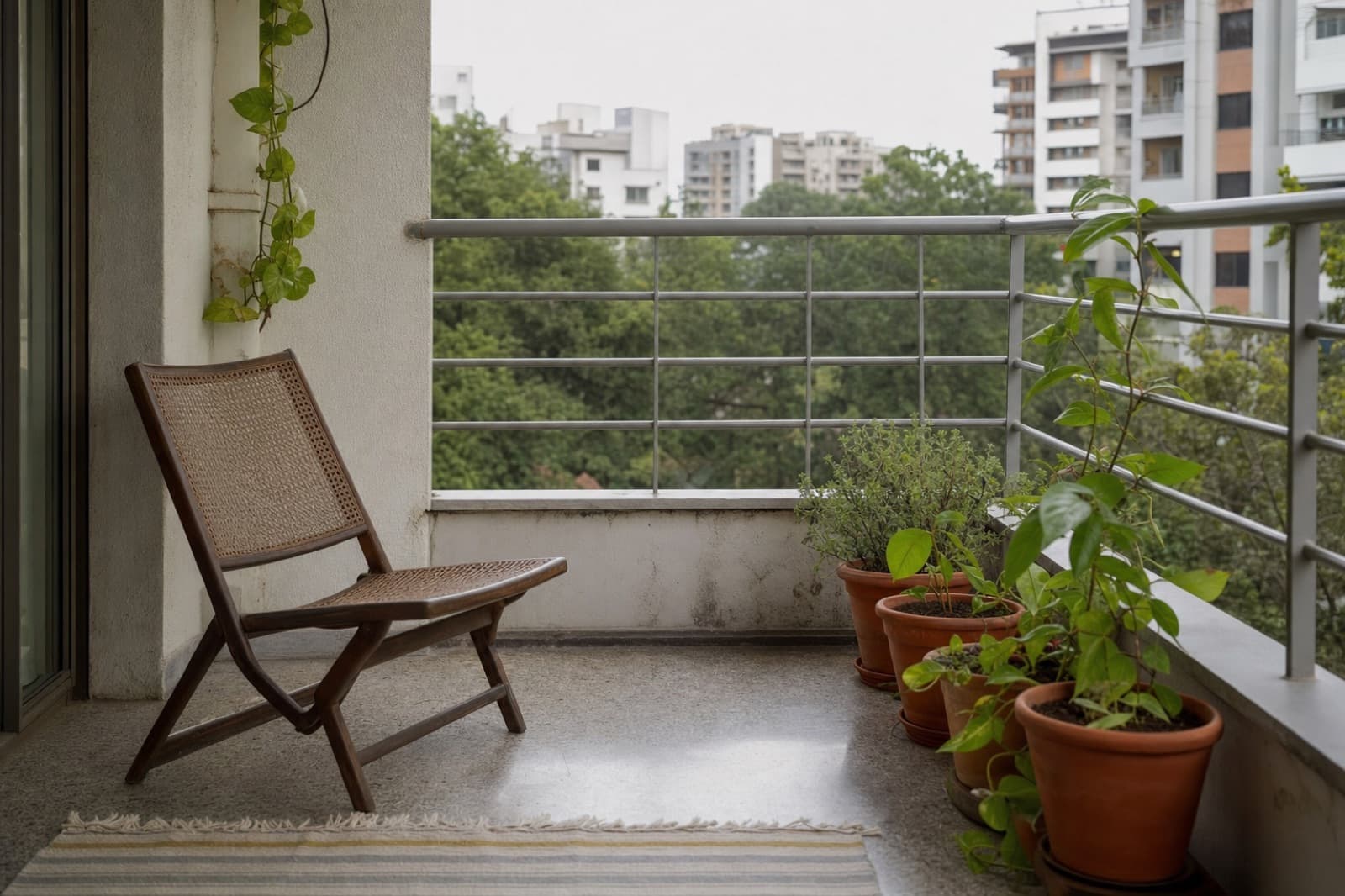
North, north-east and east: both Vastu schools rate a balcony in these zones as good. Only one reading is negative: the 8-direction school rates a south-west balcony as one to avoid, at severity 2 of 5, a mild reading. West and south balconies are neutral in both schools, and the bigger issue there is afternoon heat.
Here we set out the balcony direction as per Vastu under both schools that Vastu16 uses, what to keep on a balcony, and the heat and glare side that matters as much for daily comfort. Many buyers treat the balcony as the deciding feature of a flat. The reading is real, but it carries less weight than the entrance, kitchen or toilets.
Next: your whole home. Rules are general. Your plan is specific. Upload it and see where each room of your home falls under both schools.
Stand in the middle of your home. Which way is your balcony? Tap its zone on the wheel.
Good Neutral Avoid North is up. Zones are measured from the centre of the home.
Balcony direction as per Vastu under both schools
A balcony takes the zone that holds the largest share of its area, measured from the centre of the flat [1]. A long balcony can cross two zones. The one with more of the balcony in it decides the reading.
| Zone of the flat | 16-zone school | Traditional 8-direction school |
|---|---|---|
| North, NNE, north-east, ENE, east | good | good (north, north-east, east) |
| South-east, south | neutral | neutral |
| South-west | neutral | avoid, severity 2 of 5 |
| West, north-west | neutral | neutral |
The two schools differ most in the south-west. They also differ at two thin edges, the NNW and ESE zones, which the 16-zone school reads as neutral and the 8-direction school counts, in part, inside its good north and east. In the south-west, the 16-zone school sets no rule for a balcony there, so it is neutral. The 8-direction school reads a large opening in the south-west as less preferred, at the lowest-but-one severity [1]. In Vastu16's scoring, each severity point removes 4 points from a school's score of 100, so a south-west balcony costs 8 points in one school and nothing in the other [1].
Neither school rates a balcony anywhere as severity 3 or higher.
South-west and west balconies
A balcony in the south-west of a flat is common in towers where the best views face that way. Under Vastu16's rule table it is a mild reading in one school, not a defect that sinks a flat [1].
The physical side matters more. The Handbook on Energy Conscious Buildings (IIT Bombay and MNRE) modelled the annual cooling load of a block with one glazed wall in six Indian cities. In warm climates the load was highest with the glass facing south-west, and the handbook advises avoiding that orientation [3]. The Eco-Niwas Samhita gives the same picture in its heat-gain weights for latitudes under 23.5 N: west 1.156, east 1.155, south-west 1.124, against north 0.659 [2].
So a south-west or west balcony with full-height glass doors brings more afternoon heat into the room behind it. That is a comfort and electricity question, and it applies whatever you think of Vastu. Our page on west facing homes covers the door readings for that side, and our post on west facing flats covers the flat as a whole.
What to keep on a balcony
Vastu16's remedy list for balconies is short [1]:
- Free: keep the balcony light and uncluttered.
- Low cost: place heavier planters and storage on its south or west side.
The second line follows a wider practitioner rule that Vastu16's furniture guidance also carries: heavy items along the south and west, and the north-east of each space kept light and open [1].
What this means on a real balcony:
- A washing machine or storage cabinet goes against the south or west wall of the balcony, not the north-east corner.
- Large pots sit on the south or west edge. Small pots and seating can go anywhere.
- Keep the floor clear enough that the balcony door opens fully and water drains.
None of these is scored. They are low-cost steps, and none needs a purchase beyond the planters you already want.
Afternoon sun, glare and shading
The National Building Code (Part 8, cl. 3.4.1.1) says that except in the cold zone, sun-breakers should be provided to cut off direct sunlight, both heat and glare [4]. The code's solar table shows east and west walls receive more radiation in summer than in winter, while a south wall receives far more in winter than in summer [4].
For a balcony this gives a simple order of priority:
- West and south-west balconies need shading most: a deep overhang, a fixed vertical fin or an outdoor blind.
- East balconies receive as much radiation as west ones in the code's table and the Eco-Niwas weights, but it arrives in the morning. Glare is the main nuisance.
- South balconies get far more sun in winter than in summer at Indian latitudes, per the same table.
- North balconies get the least direct sun of all, per the Eco-Niwas weights [2].
Shading is the change that a flat owner can make without touching structure.
Checklist
Balcony check on a site visit
- Find the centre of the flat on the plan, then the balcony's zone from it.
- If the balcony crosses two zones, note which holds more of its area.
- Check the North arrow against a satellite map or a phone compass before trusting the zone.
- Look at the glazing behind the balcony. Full-height glass on the west or south-west means afternoon heat.
- Look for an overhang or fins. If there are none, plan an outdoor blind.
- Decide where heavy items go: south or west side of the balcony.
- Read the brochure's carpet area and balcony area as separate figures.
On the last point: the RERA Act (s. 2(k)) excludes an exclusive balcony from carpet area, and s. 4(2)(h) requires the promoter to disclose the exclusive balcony area separately [5]. A balcony should never be priced as if it were room area. Our Vastu for flats page covers the other rooms to check, and the 2 BHK flat page shows the readings for the most common layout.
What is tradition and what is fact
Tradition
- Balconies in the north and east zones are good in both schools (Vastu16 rule table, from practitioner guidance).
- A large opening in the south-west is less preferred in the 8-direction school.
- Heavy items to the south and west, north-east kept light (practitioner guidance in Vastu16's remedy and furniture lists).
Physical fact
- Glazing facing south-west gives the highest modelled cooling load in warm Indian climates (Handbook on Energy Conscious Buildings, Fig. 3.2).
- Heat-gain weights under 23.5 N: west 1.156, south-west 1.124, north 0.659 (Eco-Niwas Samhita 2024, Table 49).
- Sun-breakers recommended except in the cold zone (NBC 2016 Part 8, cl. 3.4.1.1).
- Carpet area excludes exclusive balconies (RERA Act s. 2(k)).
Where Vastu16 fits
You can check your balcony and every room under both schools by tagging the balcony on your floor plan. The check gives its zone, the reading in each school, and a note if it sits within 5 degrees of a zone line. It does not measure heat, glare or shading, and it does not judge the view. The full balcony rules are on our methodology page.
Questions people ask
Which direction is best for a balcony as per Vastu?
North, north-east and east are rated good in both schools that Vastu16 uses. The 16-zone school also rates north-north-east and east-north-east as good. A north or east balcony also gets less afternoon heat than a west or south-west one, according to Indian building energy codes.
Is a south-west balcony bad?
The 8-direction school reads a south-west balcony as one to avoid at severity 2 of 5, a mild reading. The 16-zone school sets no rule for it, so it is neutral. The practical concern is afternoon heat through the glass behind it, which shading reduces. Keep heavier planters on its south or west side.
Does balcony direction decide the facing of a flat?
Not on Vastu16. A home faces the direction you look towards when you stand at the main door and look out. Some practitioners use the balcony side for flats, so two people can call the same flat by different facings. The balcony is read as its own zone, separately from the entrance.
Related posts
West facing flat Vastu: what to check before booking
A west facing flat is not a defect in either school. How the entrance zone, balcony and afternoon sun decide whether one suits you.
Are west facing homes hotter? Sun, heat and Vastu
West walls take the afternoon sun. What building science says about west glazing in Indian cities, where it agrees with Vastu and where it does not.
Corner flat Vastu: two open sides, light and zones
Corner flat Vastu: a corner unit has two outside walls. How Vastu reads its openings and zones, and the light and heat trade-offs to check first.
Sources
- Vastu16 methodology and rule table (internal)
- Eco-Niwas Samhita (ENS) 2024, Energy Conservation and Sustainable Building Code (residential)
- Handbook on Energy Conscious Buildings (Nayak and Prajapati, IIT Bombay and Solar Energy Centre, MNRE, pilot edition May 2006)
- National Building Code of India 2016, Volume 2, Part 8 Building Services, Section 1 Lighting and Natural Ventilation
- The Real Estate (Regulation and Development) Act, 2016 (No. 16 of 2016), Gazette of India Extraordinary text