 Vastu16
Which floor is good as per Vastu? What the texts say

No classical text in our library ranks floors or floor numbers. So which floor is good as per Vastu has no textual answer: the same unit plan stacked on the 3rd and the 14th floor reads the same. What does change between floors is physical, and you can check it: light, heat, view, noise and the lift.
At Vastu16 we read a flat from its floor plan and the direction of North, under the 16-zone school and the traditional 8-direction school. Floor number is not an input. What still applies to a flat in a tower is on our Vastu for a flat page. This post is about the floor decision your family is asking you to make.
Next: your whole home. Rules are general. Your plan is specific. Upload it and see where each room of your home falls under both schools.
Which floor is good as per Vastu: the short answer
Pick the unit plan first, then the floor. If two floors offer the identical plan in the identical stack, the Vastu reading is the same on both, so the choice comes down to what you can see and measure on a visit.
| Question | Does it change by floor? | Why |
|---|---|---|
| Zone of each room | No | Same plan, same North |
| Vastu score in either school | No | Scored from zones only |
| Morning and evening light | Yes | Neighbouring buildings block lower floors more |
| Heat | Yes | A top floor sits under the roof |
| Noise and dust from the road | Yes | Varies with height and distance |
| Water pressure and lift wait | Yes | Depends on the building's systems |
Our methodology page lists every input the reading uses; floor is not one of them.
Floor numbers and numerology are not in the classical texts
The Mayamata, the Manasara and the house-building chapter of the Brihat Samhita describe sites, grids, halls, doors and room positions for houses that stand on their own land [1][2][3]. None of the passages we read assigns meaning to the storey a home sits on, and none mentions a numbered floor.
Ideas that the 4th, 8th or 13th floor is lucky or unlucky come from numerology and local custom. Vastu16 does not use numerology or astrology. If a relative quotes a floor number rule, the honest reply is that it is not from the texts we have read, and it is not something our check reads.
The texts do have dimension formulae, called ayadi, which adjust a building's measurements so they count as auspicious [1]. Those apply to the measurements of a house, not to which floor of a tower you buy. Our Vastu FAQ covers how the score itself is built.
What tradition says about height, weight and the south-west
Two classical ideas get stretched into floor advice.
The first is slope and elevation. The Mayamata describes a good site as rising towards the west or south (ch. 3) [1]. The Manasara wants a site elevated to the south and west (IV.2-3) [2]. The Brihat Samhita (53.115-117) says a house raised in the east or north is unfavourable and a house level on all sides is best [3]. These are rules about the ground and the house on it.
The second is the modern rule "north-east light, south-west heavy". Fazeli and Goodarzi (2010) describe it as part of Vastu guidance, mostly citing popular Vastu books [4]. None of the classical passages we read states it. Vastu16's furniture guidance follows that practice: heavy furniture along the south and west walls, the north-east kept open [5].
Neither idea says a high floor is better or worse. Moving from the 2nd floor to the 12th does not move the south-west of your flat anywhere.
What really changes between floors: light, heat, noise, water pressure
Heat. The National Building Code 2016 (Vol. 2, Part 8, Table 3) shows a flat roof receiving more solar radiation in summer than any wall at Indian latitudes [6]. A top floor flat under an exposed roof warms more, unless the roof is insulated or shaded. West walls matter on every floor: the Eco-Niwas Samhita 2024 weights west walls at 1.156 against 0.659 for north walls for heat gain at latitudes under 23.5 degrees N (Table 49) [7].
Light. On lower floors, neighbouring towers can block morning sun on east windows and the sky view that lights a room. The NBC treats any part of a room more than 7.5 m from a window as unlit (Part 3, cl. 20.1.2, Note 2), so depth matters as much as height [8].
Air. IS 3362 notes that windows placed diagonally opposite each other perform better than other layouts for most orientations, and that a room with only one outside wall does better with two windows than one (cl. 6.6-6.7) [9]. On any floor, the window layout decides how much breeze gets in.
Noise, water and lifts. These vary by building. We have no source that gives a general number for them, so measure them on the visit.
Checklist
How to choose between two floors of the same unit
Floor-choice worksheet: do this on the visit.
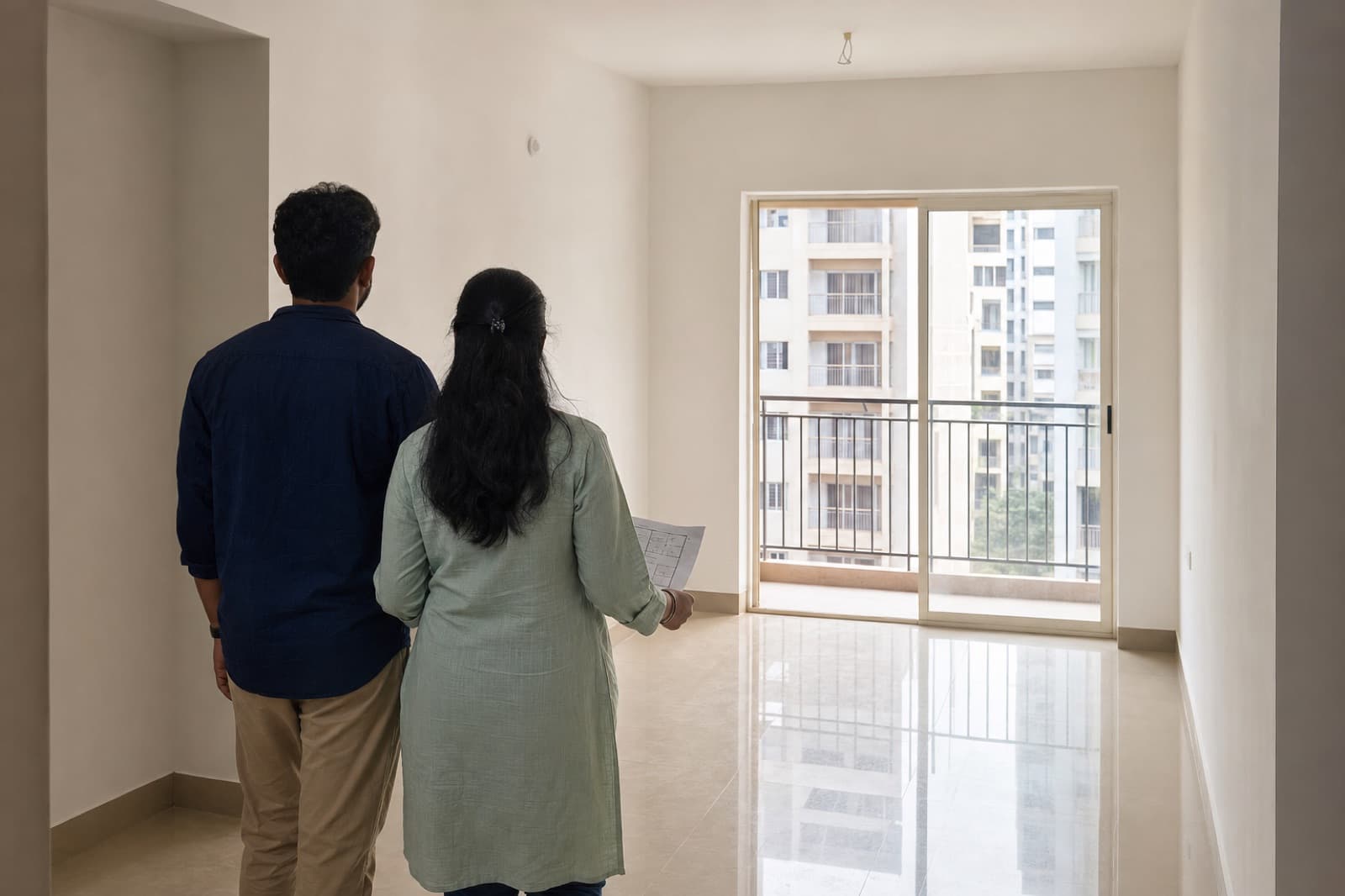
- Confirm the plan is identical. Ask for the unit plan of each floor, not the typical floor. If they match and sit in the same stack, the Vastu reading is the same; stop comparing Vastu.
- Morning light. Stand at the east window between 8 and 9 am if you can. Note what blocks the sky.
- Afternoon heat. Touch the west wall or window around 3 to 4 pm. Note its glass area and any shading.
- Roof. On the top floor, ask what roof insulation or terrace finish is planned, in writing.
- View and obstruction. Note buildings, water tanks or plant rooms in front of the main windows.
- Noise. Open the windows for five minutes at a busy hour.
- Lift wait. Time the lift at the morning rush on a working day.
- Water pressure. Run a tap and the shower on the floor you are offered.
If the two floors are different units, check each plan and compare the units side by side before you think about height. Our site visit checklist covers the rest of the visit, and the post on whether Vastu is important for flats covers what carries over from house rules at all.
What is tradition and what is fact
Tradition
- Site rising to the west or south: Mayamata ch. 3. Elevated to the south and west: Manasara IV.2-3.
- House raised in the east or north unfavourable, level best: Brihat Samhita 53.115-117.
- "North-east light, south-west heavy": modern practice, described by Fazeli and Goodarzi (2010); not stated in the classical passages we read.
Physical fact
- A roof receives more summer sun than walls: NBC 2016, Vol. 2, Part 8, Table 3.
- West walls carry a higher heat-gain weighting than north walls: Eco-Niwas Samhita 2024, Table 49, latitudes under 23.5 degrees north.
- Parts of a room more than 7.5 m from a window are treated as unlit: NBC 2016, Part 3, cl. 20.1.2.
- Vastu16's reading uses the plan and North only; floor number is not an input.
Where Vastu16 fits
If you have the unit plan, you can check the flat's floor plan under both schools once, and the result holds for every floor of that stack. The tool shows each room's zone and reading and helps you verify North. It does not rank floors, read floor numbers or measure light and heat; the worksheet does that part. Our post on Vastu myths covers other rules that are not in the texts.
Questions people ask
Which floor is best as per Vastu?
None of the classical texts we read ranks floors or floor numbers. They were written for houses on their own sites. Vastu16 reads a flat from its plan and North, so the same plan stacked on every floor gets the same reading. Choose the floor on light, heat, view, noise and lift access, which do change.
Is the 10th floor good as per Vastu?
The 10th floor is neither good nor bad in the classical texts we read; floor numbers do not appear in them. Ideas about lucky or unlucky floor numbers come from numerology, which Vastu16 does not use. Check the unit plan on the 10th floor the same way as on any other floor.
Is the top floor bad in Vastu?
No text we read says so. The physical difference is heat. The roof of a building takes more summer sun than any wall, according to the solar data in the National Building Code 2016, so a top floor flat under an exposed roof gets warmer. Ask about roof insulation and shading.
Does the Vastu of a flat change by floor?
Not if the plan is the same. Vastu16 reads each room's zone from the plan and the direction of North, and neither changes between floors of the same stack. The reading does change if a floor has a different plan, such as a refuge floor, a duplex or a penthouse, or if you compare a different stack.
Related posts
Vastu checklist before buying a flat: 20 site checks
A 20-point Vastu checklist for the site visit: North, entrance, kitchen, toilets, balcony, light and the documents to ask the builder for.
Is Vastu important for flats? How the rules translate
Is Vastu important for flats? The rules were written for houses on open plots. What carries over to a flat in a tower, and what does not.
12 Vastu myths, checked against the texts
South facing homes are bad, a north-east toilet cannot be lived with, cactus is unlucky: 12 popular Vastu myths checked against the texts.

Sources
- Mayamata (Dagens critical edition and English translation), Vol. I
- Manasara (Acharya translation, 1934)
- Brihat Samhita of Varahamihira (chapter on house-building)
- Fazeli and Goodarzi (2010), Vastu as environmental belief system
- Vastu16 methodology and rule table (internal)
- National Building Code of India 2016, Volume 2, Part 8 Building Services, Section 1 Lighting and Natural Ventilation
- Eco-Niwas Samhita (ENS) 2024, Energy Conservation and Sustainable Building Code (residential)
- NBC 2016, Volume 1, Part 3 Development Control Rules and General Building Requirements
- IS 3362:1977 Code of practice for natural ventilation of residential buildings (reaffirmed 2004)