Vastu16
Mirror image flats: why the same plan reads differently
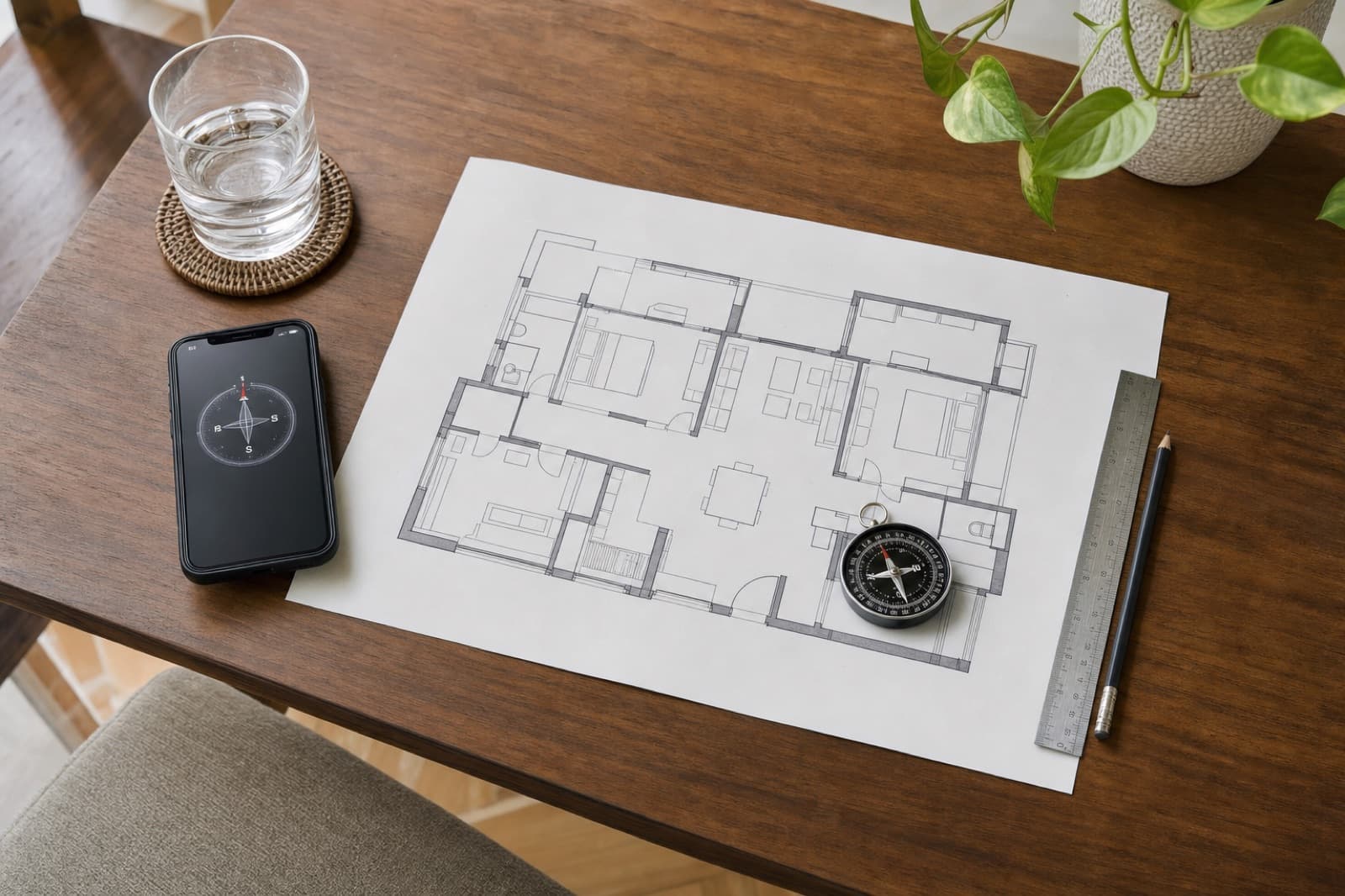
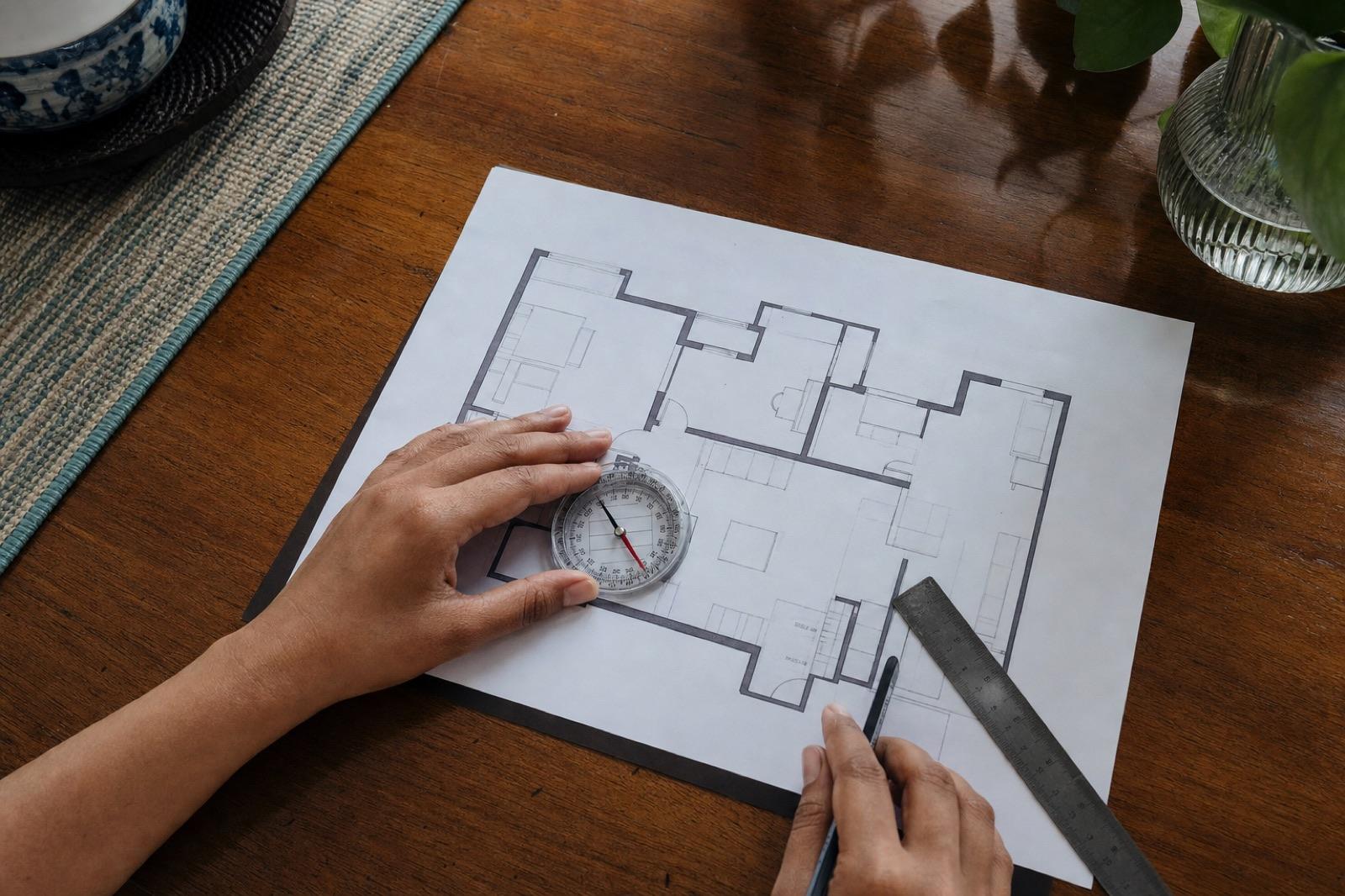
2 units with one layout can get different Vastu readings when one is the mirror image of the other. Flipping a plan left to right keeps every room but swaps east for west, and North does not move. That is the core of mirror image flat Vastu: a north-east toilet in one unit becomes a north-west toilet in its twin.
At Vastu16 we read each room's zone under the 16-zone school and the traditional 8-direction school. Our compare flats tool ranks units once you have checked them. This post explains why mirrored units differ, so the ranking makes sense.
Next: your whole home. Rules are general. Your plan is specific. Upload it and see where each room of your home falls under both schools.
Mirror image flat Vastu: the short answer
Towers often place two units on a floor as mirror images, sharing a wall, a lobby or a shaft. The builder draws one plan and shows one sample flat. The brochure calls both "Type A".
| What mirroring changes | What it keeps |
|---|---|
| East and west sides of every room (left-right flip) | The rooms, their sizes and their links |
| North and south sides of every room (top-bottom flip) | The direction of North on the drawing |
| Which zone each room sits in | The floor area and the number of rooms |
Because Vastu reads position, not shape, the reading changes. Which rooms are hit depends on the layout.
What mirroring does to zones
Picture the plan with North at the top. A left-right mirror moves a room at the top right to the top left. In compass terms, north-east becomes north-west, east becomes west, and south-east becomes south-west. North and south stay where they are.
A top-bottom mirror does the opposite: north-east becomes south-east, and east and west stay put. Towers use both arrangements.
The 16-zone school has 16 zones of 22.5 degrees each, so it notices smaller shifts than the 8-direction school, which has 8 zones of 45 degrees [1]. A main door near the middle of the north wall can stay "north" under the 8-direction school after mirroring and still change zone under the 16-zone school. Our worked example shows exactly that.
Worked example: a 2 BHK flipped left to right
We drew a simple 2 BHK with North at the top and ran it through our engine, then mirrored it left to right. Readings are from Vastu16's rule table [1].
| Room | Unit A | Unit B (mirror) |
|---|---|---|
| Main door | NNE, good (16-zone); N, good (8-direction) | NNW, neutral; N, good |
| Toilet | NE, avoid 5 of 5 in both schools | NW, neutral (16-zone); good (8-direction) |
| Kitchen | SE, good in both | SW, avoid 3 of 5 in both |
| Master bedroom | SW, good in both | SE, neutral (16-zone); avoid 2 of 5 (8-direction) |
| Second bedroom | WNW, avoid 2 of 5 (16-zone); NW, good (8-direction) | ENE, neutral; NE, neutral |
| Score, 16-zone | 72 | 88 |
| Score, 8-direction | 80 | 80 |
| Combined | 76 | 84 |
Two things stand out. Unit A carries one 5 of 5 finding; unit B carries none, but has a kitchen rated 3 of 5. And the 8-direction score is 80 for both units, from entirely different findings. A score alone hides that, which is why the findings matter. Our 2 BHK flat page covers how each room in a 2 BHK is read.
Mirror plus rotation: units on different faces of a tower
A tower with four units a floor often uses one plan turned to face each side. That is a rotation, not a mirror, and it changes every room at once.
We took unit A and turned it so the plan's top faces west instead of north. Under the 16-zone school the main door moved to WNW, avoid 3 of 5; the kitchen moved to the north-east, avoid 4 of 5 in both schools; the second bedroom moved to SSW, avoid 2 of 5 [1]. The combined score fell to 70.
So a unit can differ from the sample flat in two ways at once: flipped, and turned. Which way your unit faces is the first thing to settle; our post on how to know the facing of a flat covers it. A North arrow copied from the sample plan to every unit type is a common source of error, as our post on the brochure North arrow explains.
Checklist
How to check your exact unit, not the sample
Steps, in order:
- Get the plan for your unit number, not the type. Ask the builder which unit on the floor plate is yours and whether its plan is the drawing shown or its mirror.
- Find your unit on the floor plate. Note which face of the tower it sits on and which units it shares walls with.
- Flip the sample if needed. If you only have the twin's plan, upload it to the free check and use "Mirror left to right" or "Mirror top to bottom". The tool flips the drawing and your room tags and keeps North where it was, which matches a real mirror unit.
- Re-verify North for that face of the tower. Match the building on a satellite map; our guide on how to find North for Vastu shows how. A phone compass inside a steel and concrete tower can be pulled off; NOAA notes local anomalies of 3 to 4 degrees are not uncommon [2].
- Save both readings under clear names, such as "B-1203" and "B-1204".
- Compare them side by side. Look first at findings rated 4 or 5, then at the scores.
What is tradition and what is fact
Tradition
- Zone ratings and severities for each room: Vastu16's rule table, 16-zone and 8-direction schools.
- The 16-zone school divides the plan into 16 zones of 22.5 degrees; the 8-direction school into 8 zones of 45 degrees.
Physical fact
- A left-right mirror swaps east and west positions and leaves North unchanged on the drawing; a top-bottom mirror swaps north and south. This is geometry.
- Phone compasses inside buildings can be off by local anomalies; 3 to 4 degrees is not uncommon (NOAA NCEI).
- The worked example scores come from running the plan through Vastu16's engine, ruleset 0.1.0-draft.
Where Vastu16 fits
The free tool lets you check your unit and its mirror twin from one drawing: tag the rooms, verify North, and flip the plan with the mirror buttons. It shows each room's zone and reading under both schools. It cannot tell which unit is yours or which way your face of the tower points; you confirm that from the floor plate and the map.
Questions people ask
Does a mirror image flat have the same Vastu?
Usually not. Mirroring a plan left to right keeps the rooms but swaps their east and west positions, while North stays the same. A toilet in the north-east of one unit sits in the north-west of its twin. In our worked example the two units score 76 and 84, with different findings, from one layout.
Why does my unit read differently from the sample flat?
The sample flat is one unit in one position. Your unit may be its mirror image, or the same plan on another face of the tower, which turns every room to a new direction. Either change moves rooms between zones. Ask for the plan of your unit number and check that, not the sample.
How do I check the Vastu of a flipped plan?
Upload the plan you have, tag the rooms and verify North for your unit's face of the tower. If you only have the twin unit's plan, use the mirror button in the free check. It flips the drawing and the room tags and keeps North unchanged, which is what happens in a real mirror unit.
Related posts
Is the brochure's North arrow right? How to check it
How to check the Vastu direction of a flat: test the brochure's North arrow against a satellite map, a compass and the sanctioned plan.
How to know the facing of a flat: door, balcony or tower?
Brokers say east facing, the plan says otherwise. Three definitions of a flat's facing, which one Vastu uses, and how to measure yours.
Which flat is better as per Vastu? Compare two units
Which flat is better as per Vastu? A fair way to compare two or three units: one North check, the same rooms tagged, defects ranked by severity first.