 Vastu16
Plants as per Vastu: what tradition says, where to keep them
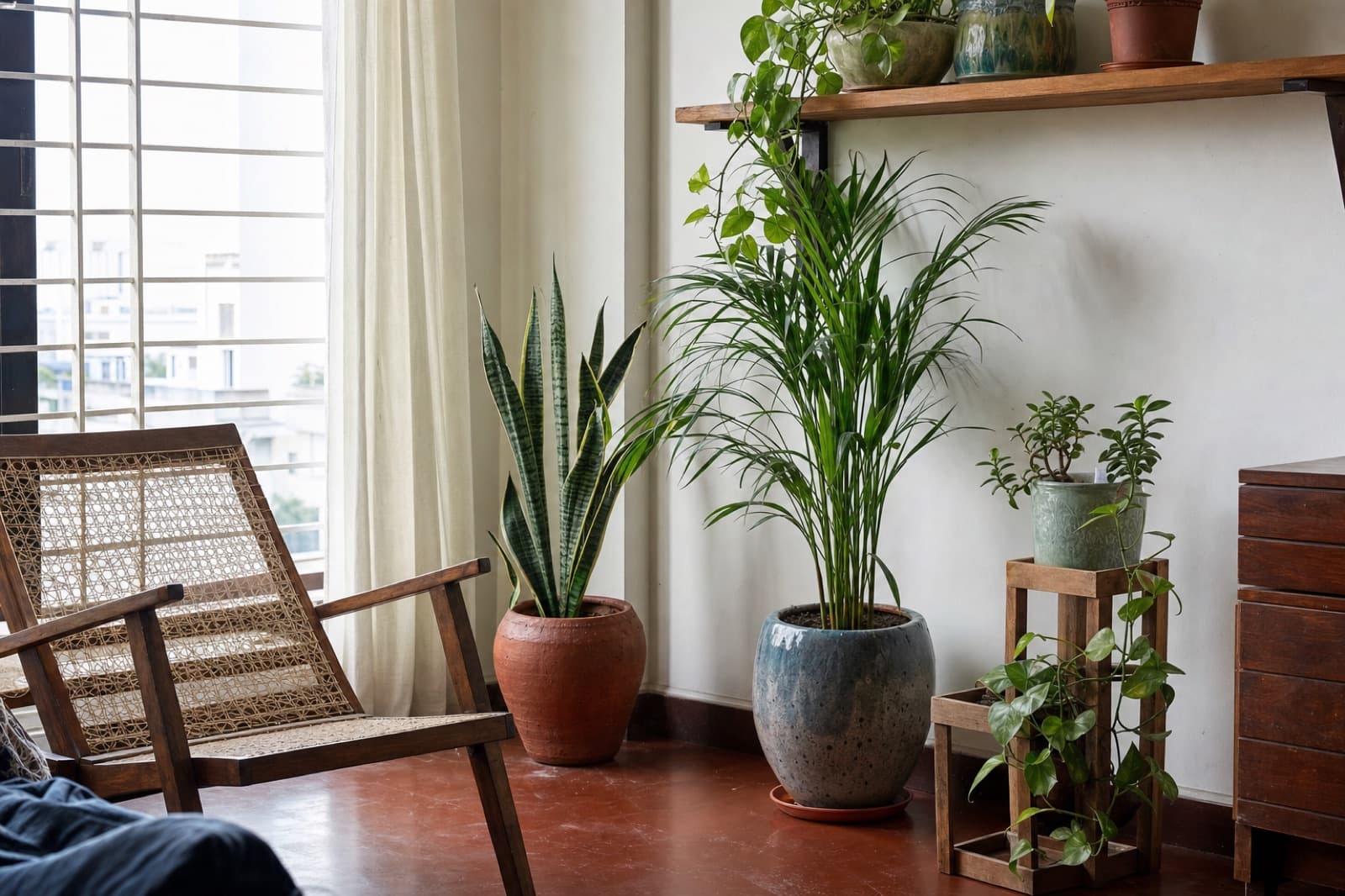
Three directions come up again and again: north-east, east and north. Popular Vastu guidance places tulsi there, puts the money plant in the south-east, and keeps cactus outside or by a window. None of this is in Vastu16's scored rules. The light each plant needs matters more for whether it survives.
Vastu16's check does not score plants. What follows on plants as per Vastu is popular practitioner guidance, attributed to the pages it comes from, set beside the care facts from a university plant database. Where your family has strong views, this page lets you see which parts are custom and which parts are horticulture. The rooms themselves are covered on our Vastu for home page, and Vastu16 publishes every rule it does score.
Next: your whole home. Rules are general. Your plan is specific. Upload it and see where each room of your home falls under both schools.
Plants as per Vastu: what tradition says
The classical texts we read discuss trees on a plot, not pot plants. The Brihat Samhita has verses on trees near a house (53.85-87) and on which trees not to fell for building timber (53.120-123) [2]. Those are about large trees in a compound and in the forest, which is a different question from a tulsi on a balcony.
The rules most families quote come from modern practitioners and popular guides. Livspace's Vastu plant guide names the east, north and north-east as the most favourable directions for plants and discourages plants in the south-west [3]. It also shows how loose the guidance is: the same article recommends the north-east for a large plant in one section and, in its FAQ, says large plants are not recommended there [3].
So treat plant rules as custom with many versions. Vastu16 does not take a side on them.
Tulsi and the north-east or east
Tulsi is the plant with the strongest tradition behind it in most Indian homes. Brick & Bolt's guide places it in the north-east, east or north, and says the south and south-east are commonly avoided [4]. Livspace places it in the east [3]. Both mention keeping it raised, on a stand or a Tulsi Vrindavan, and away from shoes, brooms and bins [4].
The horticulture is clear. NC State Extension describes holy basil as a short-lived perennial from tropical southern Asia that prefers full sun, listed as 6 or more hours of direct sunlight a day, in moist, well-drained soil. It does poorly in waterlogged soil [5].
That creates a common conflict. A north-east corner of a flat may get very little direct sun. Brick & Bolt's own guide says that if the preferred direction has no sun, choose the brightest practical spot [4]. We agree: a healthy tulsi on a sunny south balcony is a better outcome than a weak one in a dark north-east corner. Our post on balcony direction as per Vastu shows how much sun each side of a flat gets.
Plants people avoid, and why
Cactus. Livspace reports the belief that thorny plants bring tension indoors, then adds that a cactus on a terrace or by a window is acceptable [3]. The care fact: NC State's entry for bunny ears cactus lists full sun to partial shade, a fast-draining mix and dry soil between waterings, and advises gloves because its bristles detach at a touch [7]. A sunny windowsill is where it does best anyway.
Bonsai and dead plants. Livspace discourages both [3]. A dead plant is easy to agree on.
Money plant. Not avoided; it is one of the most recommended. Livspace places it in the south-east, and lists it for the east in some interpretations [3]. The plant sold as money plant in India is pothos. NC State describes pothos as preferring bright, indirect light and surviving long periods in low light, and lists it as poisonous to cats, dogs and horses because of calcium oxalate crystals [6]. If you have pets, keep it out of their reach.
The Vastu FAQ covers other common beliefs and how Vastu16 treats them.
Light and care by balcony direction
The National Building Code's solar table shows south faces receive far more radiation in winter than in summer, while east and west faces receive more in summer [8]. The Eco-Niwas Samhita's heat-gain weights give north faces the least sun of all eight sides, at 0.659 against about 1.15 for east and west, in the column for latitudes south of 23.5° N [9].
| Balcony or window faces | Direct sun (physical) | Suits well (care) | Traditional note |
|---|---|---|---|
| North | Least (weight 0.659) | Pothos (money plant), which tolerates low light | North is favoured for flowering plants |
| East | Morning sun, more in summer than winter | Tulsi if it gets enough hours | East is favoured for tulsi |
| North-east | Moderate (weight 0.906, between north and east) | Pothos; tulsi only if sunny enough | Most favoured for tulsi in popular guides |
| South | Strong in winter, less in summer | Tulsi in winter; cactus | South is commonly avoided for tulsi |
| South-east | High (weight 1.125, close to east) | Tulsi, cactus | Money plant favoured; tulsi avoided |
| West | Afternoon sun, more in summer than winter | Cactus | Not favoured for most plants |
| South-west | High (weight 1.124) | Cactus | Plants discouraged in popular guides |
The traditional column is popular guidance, not a Vastu16 rule [3][4].
Checklist
Place your plants: step by step
- Note which way each balcony and window faces, using the floor plan and a phone compass.
- Watch each spot for a day: count the hours of direct sun.
- Tulsi: pick the sunniest spot among north-east, east and north. If none gets real sun, use the sunniest spot you have.
- Money plant: north or north-east is fine for light; keep it away from pets.
- Cactus: a sunny window or the balcony edge.
- Heavy planters on the south or west side of a balcony, per Vastu16's balcony remedy [1].
- Remove dead or dying plants.
- Water to each plant's needs: tulsi moist but not waterlogged, cactus and pothos dry between waterings.
Our post on moving into a new home fits plants into the first-week order.
What is tradition and what is fact
Tradition
- Tulsi in the north-east, east or north; south and south-east avoided (Brick & Bolt; Livspace).
- Money plant in the south-east, or the east in some versions; cactus outside or by a window (Livspace).
- Plants favoured in the east, north and north-east; discouraged in the south-west (Livspace).
- The classical texts we read discuss trees near a house and trees for timber (Brihat Samhita 53.85-87, 120-123), not pot plants.
Physical fact
- Holy basil prefers full sun, 6 or more hours a day, and does poorly in waterlogged soil (NC State Extension).
- Pothos prefers bright, indirect light, tolerates low light, and is poisonous to cats, dogs and horses (NC State Extension).
- South faces get far more sun in winter than in summer; north faces get the least (NBC 2016 Part 8 Table 3; Eco-Niwas Samhita Table 49, latitudes under 23.5 degrees north).
Where Vastu16 fits
Plants are not part of the score. You can still check your flat's balconies and rooms under both schools to see which zones each balcony sits in, which tells you where the north-east, east and north of the home really are. The check does not measure sunlight or recommend plants. Our Vastu for flats page covers the rooms that are scored.
Questions people ask
Which plants are good as per Vastu?
Popular guides most often recommend tulsi, the money plant (pothos), jade and bamboo, and discourage cactus indoors, bonsai and dead plants. These are practitioner beliefs, not classical rules, and Vastu16 does not score plants. Pick plants that suit the light in your home, then place them by the traditional notes if your family follows them.
Where should tulsi be kept?
Popular Vastu guides place tulsi in the north-east, east or north of the home, and commonly avoid the south and south-east. Holy basil needs full sun, 6 or more hours a day, and well-drained soil. If the preferred direction is dark, the sunniest balcony or window you have is the better choice for the plant.
Is a cactus bad as per Vastu?
Some popular guides discourage a cactus indoors because of its thorns, and the same guides say a cactus on a terrace or by a window is acceptable. That is a belief, not a rule in the classical texts we read. A cactus needs strong light and dry soil, so a sunny window suits it in any case.
Related posts
Balcony direction as per Vastu: what to check
Balconies to the north and east are preferred in both schools. How a south-west balcony is read, what to keep on it, and the heat side of it.
Moving into a new home: a first-week Vastu checklist
A practical first-week checklist for a new home: where furniture goes, what to fix first, and Vastu steps that need no purchases.
12 Vastu myths, checked against the texts
South facing homes are bad, a north-east toilet cannot be lived with, cactus is unlucky: 12 popular Vastu myths checked against the texts.
Sources
- Vastu16 methodology and rule table (internal)
- Brihat Samhita of Varahamihira (chapter on house-building)
- Livspace, "Everything You Need To Know About Vastu Shastra for Plants"
- Brick & Bolt, "Where to Keep Tulsi Plant at Home According to Vastu"
- NC State Extension Plant Toolbox, "Ocimum tenuiflorum" (holy basil)
- NC State Extension Plant Toolbox, "Epipremnum aureum" (pothos, sold in India as money plant)
- NC State Extension Plant Toolbox, "Opuntia microdasys" (bunny ears cactus)
- National Building Code of India 2016, Volume 2, Part 8 Building Services, Section 1 Lighting and Natural Ventilation
- Eco-Niwas Samhita (ENS) 2024, Energy Conservation and Sustainable Building Code (residential)