 Vastu16
Attached bathroom Vastu: master bedroom and en-suites
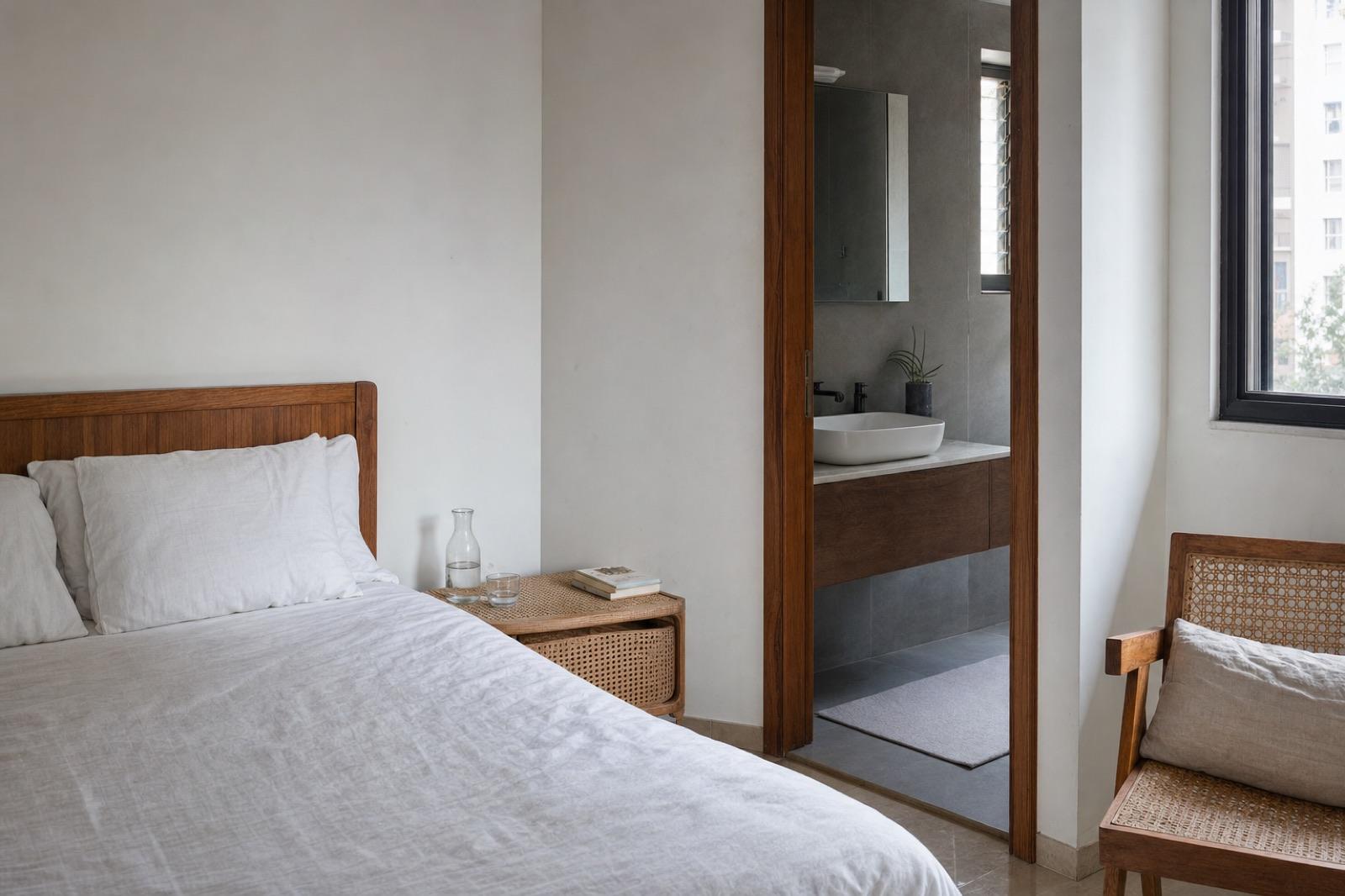
Severity 5 of 5 is the worst case, and it depends on the zone, not on the door. An attached bathroom is not a defect in itself under either school Vastu16 uses. What matters is where the WC sits from the centre of the whole flat, then the shared wall, the closed door and dry air.
Next: your whole home. Rules are general. Your plan is specific. Upload it and see where each room of your home falls under both schools.
Stand in the middle of your home. Which way is your toilet? Tap its zone on the wheel.
Good Neutral Avoid North is up. Zones are measured from the centre of the home.
Attached bathroom as per Vastu: the short answer
Attached bathroom Vastu questions come up because almost every bedroom in a new flat has one. The good news is that neither school in Vastu16's rule table marks a bathroom down for being en-suite [1]. Both read the WC by its zone in the home.
A WC in the north-east or at the centre of the home is the most serious finding in both schools, at severity 5 of 5. A WC in the south-west reads severity 4 of 5. In the north-west, the 8-direction school reads a WC as good and the 16-zone school rates its WNW zone good and the rest neutral [1].
The rest is the bedroom side of the pair: which wall the bed shares with the WC, whether the door stays shut, and whether the exhaust keeps the room dry. None of those needs plumbing work. For the full reading of a toilet anywhere in the home, see where the toilet should be as per Vastu.
Attached bathroom Vastu starts at the home's centre
The most common mistake is reading the en-suite from the middle of the bedroom. Both schools read a room from the centre of the whole flat. Draw a line from the flat's centre to the WC and read the direction of that line [1].
The 16-zone school cuts the home into sixteen slices of 22.5 degrees; the 8-direction school uses eight of 45 degrees [1]. Here is how each reads a WC.
| Area of the flat | 8-direction school | 16-zone school |
|---|---|---|
| North-east | Avoid, 5 of 5 | NNE and NE avoid 5 of 5; ENE neutral |
| North | Avoid, 2 of 5 | NNW neutral; N and NNE avoid 5 of 5 |
| East | Avoid, 2 of 5 | E avoid 2 of 5; ESE good |
| South-east | Neutral | ESE good; SE avoid 4 of 5; SSE neutral |
| South | Neutral | S avoid 2 of 5; SSW good |
| South-west | Avoid, 4 of 5 | SSW good; SW avoid 4 of 5; WSW neutral |
| West | Good | W avoid 2 of 5; WNW good |
| North-west | Good | WNW good; NW and NNW neutral |
| Centre | Avoid, 5 of 5 | Avoid, 5 of 5 |
The schools disagree in most areas, most sharply in the west and the south-east, which is why the check reports both. A south-west WC has its own page: toilet in the south-west.
The shared wall with the bed
Vastu16's check does not score which wall the bed shares with the bathroom. What follows is practitioner guidance, not a rule from our table.
Some practitioners advise keeping the bed off a wall shared with a bathroom or WC, and suggest a few inches of gap or a solid wooden headboard where no other wall works [2]. The same page names plumbing noise as a practical reason [2]. That part needs no belief: a cistern refilling at 2 a.m. behind your pillow is easy to hear in a flat with thin partition walls.
The bed rule that our table does give is about the head direction. Vastu16's guidance recommends the head to the south or east and advises against the north [1]. So if the only free wall for the headboard is the WC wall and it points north, swapping walls solves two things at once. More on choosing the room itself is on our bedroom direction page.
Door, exhaust and damp
Three free or cheap steps come straight from the remedies in Vastu16's table: keep the toilet door closed and the seat lid down; keep it dry, clean and ventilated and fix any leaking tap or flush; fit an exhaust fan if there is none [1].
The physical case for the exhaust is strong. The National Building Code 2016 requires every bathroom or WC to have at least one wall open to external air and a window or ventilator of at least 0.3 square metres opening to a shaft or open space [3]. It recommends 6 to 10 air changes an hour for bathrooms and toilets [4], and IS 3362 sets six air changes an hour for bathrooms and water-closets [5].
An en-suite matters more here than a common bathroom, because its damp air has one easy exit: into the bedroom. The WHO's guideline on dampness and mould says persistent damp and mould growth indoors should be avoided because of their links to respiratory symptoms and asthma [6]. If you have symptoms, see a doctor. A home check is not medical advice.
What to change without plumbing work
Moving a WC means breaking floors and rerouting soil pipes. Before that, these changes cost little or nothing.
- Swap who sleeps where. If the en-suite WC reads poorly, give that bedroom to a guest or use it as a study. Vastu16's remedies list that swap as the low-cost step for a bedroom in a poor zone [1].
- Move the headboard. Put it on a wall that is not the WC wall, with the head to the south or east.
- Close and dry. Door shut, lid down, exhaust on during and after a shower.
- Fix leaks this week. A dripping flush is damp you can stop for the cost of a washer.
- Treat the WC zone as fixed for now. At plan or renovation stage, the table's bigger step is moving the WC into a zone suited to disposal, or turning the space into a store or wash area [1].
Which way the seat itself faces is a separate question, covered in our post on toilet seat direction.
Checklist
En-suite check: do this in 10 minutes
| Step | What to look at | Pass if |
|---|---|---|
| 1 | Zone of the WC from the flat's centre | Not north-east, south-west or centre |
| 2 | Headboard wall | Not shared with the WC; head south or east |
| 3 | Bathroom door | Closes fully and stays closed |
| 4 | Exhaust fan or window | Works, and vents outside or to a shaft |
| 5 | Leaks | No drip at taps, flush or under the basin |
| 6 | Walls near the en-suite | No damp patch or peeling paint |
In a 3 BHK flat, run this for each en-suite, since each WC sits in a different zone.
What is tradition and what is fact
Tradition
- Reading every room from the centre of the home, with a WC rated by zone: the 16-zone and traditional 8-direction schools, as published in Vastu16's rule table [1].
- Latrines on the Nirrti (south-west) square: the Mayamata's room-placement passage (ch. 26) [7]. The modern schools avoid the south-west for a WC, so text and practice differ here.
- Bed off the WC wall: practitioner guidance, not a classical rule we found [2].
Physical fact
Where Vastu16 fits
You can check your floor plan under both schools and see the zone of every en-suite WC from the flat's true centre, with the 16-zone and 8-direction readings side by side. The check reads zones from your plan and north. It does not score the bed's shared wall, inspect plumbing or measure damp.
Questions people ask
Is an attached bathroom bad as per Vastu?
No. Neither school in Vastu16's rule table scores a bathroom for being attached to a bedroom. What gets a reading is the zone the WC sits in, measured from the centre of the whole flat. A north-east or central WC is the most serious case in both schools. In the north-west, the 8-direction school rates a WC good and the 16-zone school rates the WNW zone good.
Can the bed be against the bathroom wall?
Vastu16's check does not score the bed's shared wall. Some practitioners advise keeping the headboard off a wall shared with a WC, and plumbing noise is a plain practical reason to agree. If no other wall works, a few inches of gap or a solid headboard is the usual answer. The head should still point south or east.
Where should the attached bathroom be in the master bedroom?
Read it against the whole flat, not the bedroom. The 8-direction school rates a WC in the north-west or west as good. The 16-zone school rates the WNW, SSW and ESE zones as good. Both schools avoid the north-east, the south-west and the centre of the home for a WC.
Related posts
Toilet seat direction as per Vastu: which way to face
Which way the WC should face as per Vastu, why the guidance differs from toilet location, and what to do if the seat faces the 'wrong' way.
Wardrobe Vastu in the bedroom: wall, side and mirror
Which bedroom wall the wardrobe goes on as per common Vastu guidance, heavy furniture in the south-west, and mirrored doors facing the bed.
Kitchen and toilet sharing a wall: Vastu and hygiene
Many flats put the kitchen and toilet back to back. How Vastu reads a shared wall, what matters for hygiene, and what to change.
Sources
- Vastu16 methodology and rule table (internal)
- DesignCafe (Nikita Raikwar), "Bed Placement Mistakes as per Vastu to Avoid for Better Sleep"
- NBC 2016, Volume 1, Part 3 Development Control Rules and General Building Requirements
- National Building Code of India 2016, Volume 2, Part 8 Building Services, Section 1 Lighting and Natural Ventilation
- IS 3362:1977 Code of practice for natural ventilation of residential buildings (reaffirmed 2004)
- WHO Guidelines for Indoor Air Quality: Dampness and Mould (2009)
- Mayamata (Dagens critical edition and English translation), Vol. II