 Vastu16
Pooja unit in a flat with no pooja room: placement
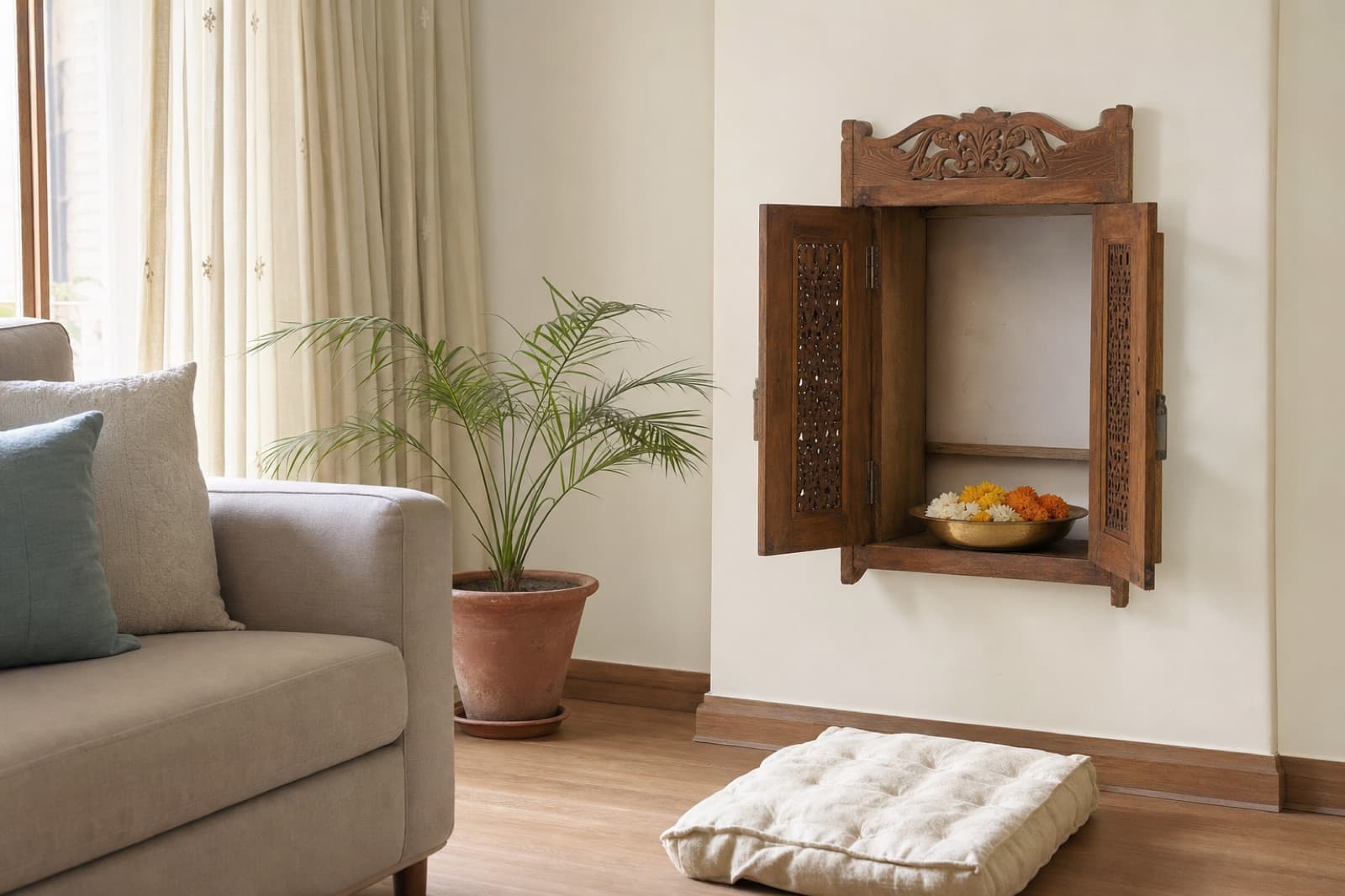
North-east first, then east or north: that is where both schools prefer prayer, and a mandir unit follows the same rule. Place it in the north-east part of the home if you can, or the north-east corner of the living room if you cannot. Face east or north while praying, and keep it off a toilet wall.
Most flats in Indian cities have no separate pooja room, so the practical question about Vastu for pooja unit placement is which corner of which room. Vastu16 reads the unit the same way it reads a pooja room: by its zone from the centre of the home. Readings for a dedicated room are on our pooja room page. This post covers a unit inside another room.
Next: your whole home. Rules are general. Your plan is specific. Upload it and see where each room of your home falls under both schools.
Stand in the middle of your home. Which way is your pooja room? Tap its zone on the wheel.
Good Neutral Avoid North is up. Zones are measured from the centre of the home.
Vastu for a pooja unit: where the schools place prayer
The classical texts place worship in the north-east. The Mayamata (ch. 26) puts the cult-ceremony room on the Isa square, the north-east [2]. The Manasara (XXXVI.30) names the Aditi or Isa quarter for three of the castes, though its previous verse puts the Brahmins' worship house in the north-west [3]. The Brihat Samhita (53.118) puts the worship room in the north-east of a four-hall house [5], and the Vishwakarma Prakash (2.94-97) puts the god-shrine in Ishanya [4].
Vastu16's two schools agree on the north-east and the east, and disagree at the edges [1]:
| Zone of the home | 16-zone school | Traditional 8-direction school |
|---|---|---|
| North-east, east | good | good |
| East-north-east | good | (falls in north-east or east: good) |
| North | neutral | good |
| West | good | neutral |
| South | neutral | avoid, severity 3 of 5 |
| South-west | neutral | avoid, severity 3 of 5 |
| South-south-west | avoid, severity 3 of 5 | (falls in south or south-west: avoid, 3 of 5) |
| ESE, WNW | avoid, severity 3 of 5 | (falls in east: good; or south-east, west, north-west: neutral) |
So a unit on the north wall is good in one school and neutral in the other. A unit in the west is the reverse. Neither school rates the N or W zone as one to avoid, though the WNW zone next to the west is a 16-zone avoid at 3 of 5.
The north-east corner of a room, not just of the home
There are two ways to read "north-east", and they can give different answers.
The first is the zone of the home. Vastu16's check measures the unit's bearing from the centre of the whole flat. That is what the score uses. If you are unsure where the centre is, our post on how to find the centre of a house walks through it.
The second is the corner of the room. Vastu16's remedy list suggests a movable prayer unit placed in the north-east part of the living room when there is no pooja room [1]. Practitioners also advise keeping the north-east of each room light and uncluttered [1].
The best spot satisfies both: the north-east corner of a room that itself sits in the north-east, east or north of the flat. If you can only have one, the zone of the home is what the check reads. The corner of the room is the next step.
Which way do you face while praying?
Face east or north. Vastu16's remedy list carries this as its first free step for prayer spaces [1], and it is common practitioner guidance. We did not find a classical verse that sets the worshipper's facing for a home shrine, so treat it as practice, not text.
In practice the facing follows from the placement. A unit on the east wall means you face east. A unit on the north wall means you face north. A unit in a north-east corner, set square to one of the two walls, gives you either.
If the only free wall puts you facing west or south, the schools do not score your facing. Vastu16's check reads where the unit is, not which way you stand. Your facing is a free adjustment, so choose the wall that allows it where you can.
Walls to avoid: toilets and stairs
Toilet walls. Vastu16's remedy list says to keep the prayer space away from a wall shared with a toilet [1]. AppliedVastu, a practitioner firm, says the same and adds that a toilet should not sit on the floor directly over or under a pooja space [6]. In a flat you often cannot check the flat upstairs, so treat the shared wall as the part you can control.
Stairs. Vastu16's table has no rule on a unit near or under a staircase, and the texts we read do not address it. The staircase remedy in our list is to keep the space under the stairs clear and not use it to store discarded items [1]. Low headroom and footfall make it a hard place to keep clean, which is reason enough to choose another wall.
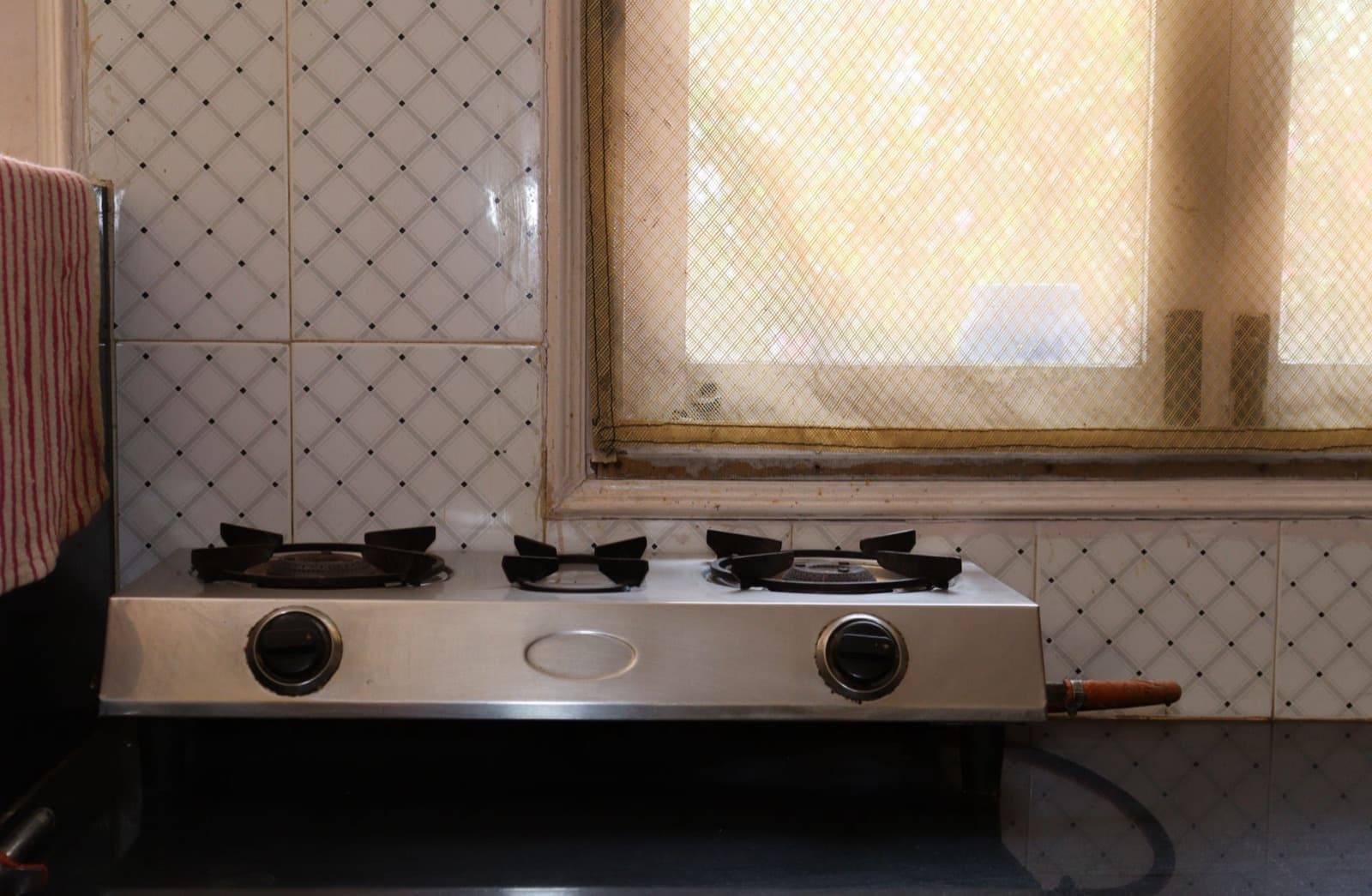
Kitchens. Not scored either. The physical point is that stoves release combustion products that build up in the kitchen [7], so a unit there collects grease and smoke faster.
Layouts for 1, 2 and 3 BHK flats
The order is the same in every size. Find which rooms sit in the north-east, east and north of the flat, then pick the one you can keep clean and quiet.
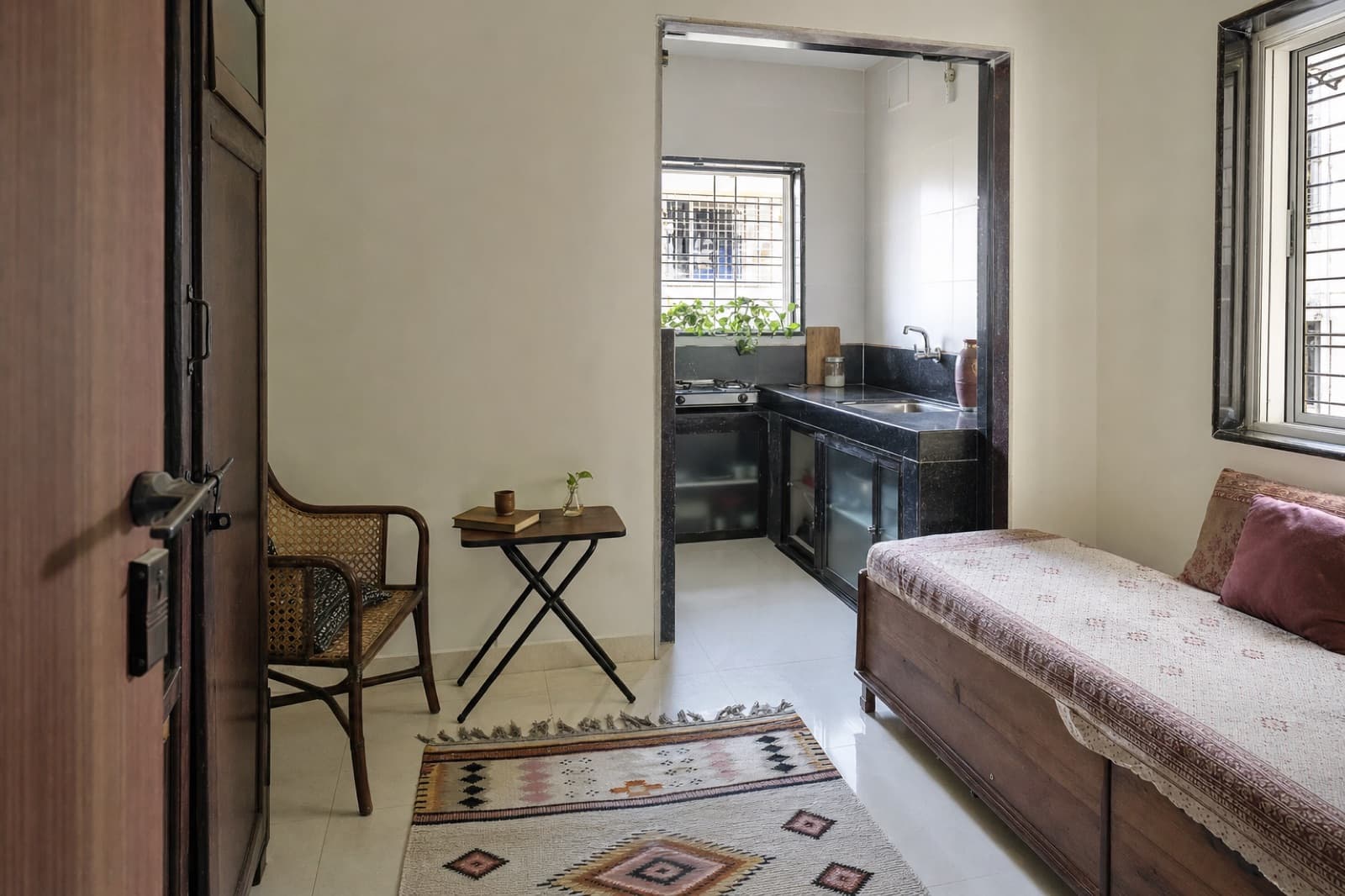
- 1 BHK. The living room is the usual choice because it is the only shared room. If the living room sits in the south or south-west, check whether the bedroom covers the north-east. Our 1 BHK flat page shows the readings for every room.
- 2 BHK. You have more walls to choose from. A north-east bedroom or the north-east end of the living room both work. See our 2 BHK flat page.
- 3 BHK. If a study or third bedroom sits in the north-east, a small corner there can be quieter than the living room.
The page is also available in Hindi for family members who prefer it.
Checklist
Place the unit: step by step
- Mark the centre of the flat on the floor plan.
- Find which rooms sit in the north-east, east and north zones.
- Pick the room you use daily and can keep clean.
- In that room, find its north-east corner with a compass or the plan's North arrow.
- Check the wall behind the unit: is a toilet on the other side? If yes, use the next wall.
- Set the unit so you face east or north while praying.
- Mount or place it at a height everyone in the family can reach and see comfortably.
- Keep the area in front of it clear and uncluttered.
What is tradition and what is fact
Tradition
- Worship in the north-east: Mayamata ch. 26, Manasara XXXVI.30, Brihat Samhita 53.118, Vishwakarma Prakash 2.94-97. The Manasara (XXXVI.29) also puts the Brahmins' worship house in the north-west.
- Facing east or north while praying: practitioner guidance, carried in Vastu16's remedy list.
- Keeping prayer away from toilet walls: practitioner guidance (AppliedVastu; Vastu16's remedy list).
Physical fact
- Gas stoves release combustion products that accumulate in a kitchen (IS 3362:1977, cl. 3.3).
- IS 3362:1977 (cl. 4.3.2) sets about six air changes an hour for a family kitchen, because cooking fumes need to leave the room.
Where Vastu16 fits
You can check where your pooja unit falls under both schools by tagging it as the pooja room on your plan. The check gives its zone from the centre of the flat, the reading in each school, and a note if it sits near a zone line. It does not read the corner of the room, the wall behind it or the way you face. Those are the free steps in this post.
Questions people ask
Where should the mandir be in a flat with no pooja room?
Both schools prefer the north-east or east of the home for prayer. In a flat, choose the room that sits in those zones and place the unit in its north-east corner. If no room covers the north-east, the north is good in the 8-direction school and the W zone, not WNW, is good in the 16-zone school.
Which direction should the pooja unit face?
Practitioners advise that you face east or north while praying, which means the unit sits on the east or north wall. Vastu16's remedy list carries this as a free step. We found no classical verse setting the worshipper's facing for a home shrine, so treat it as practice rather than a rule from the texts.
Can the mandir be in the kitchen or bedroom?
Vastu16's check does not score a mandir by the room it sits in, only by its zone in the home. A kitchen unit collects smoke and grease because stoves release combustion products. A bedroom is quieter. If either room sits in the north-east or east, it reads well in both schools.
Related posts
How to find the centre of a house for Vastu
Every zone is measured from the centre. How to find it on a rectangular plan, an L-shaped flat and an irregular plot, step by step.
Kitchen and toilet sharing a wall: Vastu and hygiene
Many flats put the kitchen and toilet back to back. How Vastu reads a shared wall, what matters for hygiene, and what to change.
Vastu for a 1 RK flat: room, kitchen and what to move
A 1 RK is one room plus a kitchen. Which Vastu checks still apply, what you can move, and how to read a 1 RK plan in five minutes.
Sources
- Vastu16 methodology and rule table (internal)
- Mayamata (Dagens critical edition and English translation), Vol. II
- Manasara (Acharya translation, 1934)
- Vishwakarma Prakash (Sanskrit with Hindi commentary "Abhaya")
- Brihat Samhita of Varahamihira (chapter on house-building)
- AppliedVastu (Apurba Das and Shouvik Das), "Toilet direction as per vastu and Bathroom direction as per vastu"
- IS 3362:1977 Code of practice for natural ventilation of residential buildings (reaffirmed 2004)